



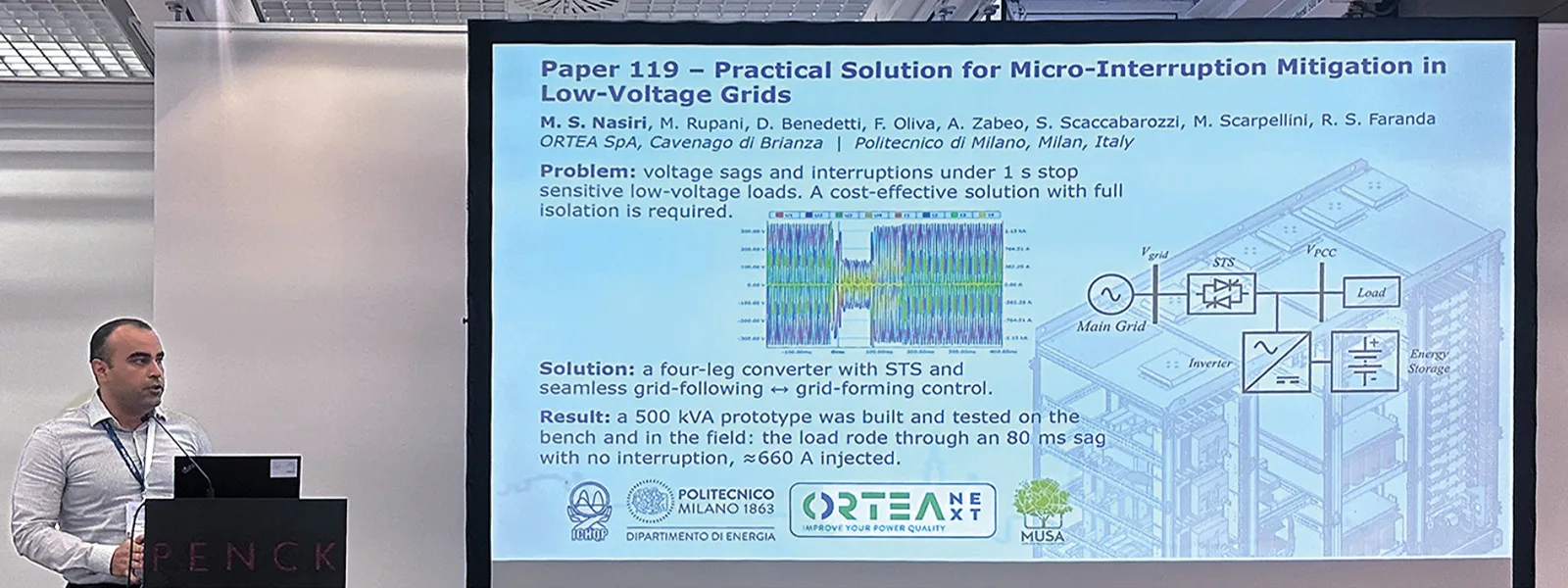
From 31 August to 3 September 2026, Dresden hosted the 22nd International Conference on Harmonics and Quality of Power (IEEE PES ICHQP). There, Mohammad Sadegh Nasiri, Executive PhD student at Politecnico di Milano and firmware engineer in the Ortea R&D department, presented the study “Practical Solution for Micro-Interruption Mitigation in Low-Voltage Grids”.
The paper addresses a problem that many industrial plants know well. A voltage sag or a micro-interruption of a few tens of milliseconds is enough to trip protection, stop a line, and cost hours of restart. EN 50160 places the most low-voltage dips below one second, and their frequency grows with the number of sensitive loads and distributed sources connected to the same feeder.
The work was carried out within the Italian national project MUSA (Multilayered Urban Sustainability Action), funded by the European Union – NextGenerationEU under the National Recovery and Resilience Plan.
“Eighty milliseconds are nothing on paper, but they are enough to stop a plant. This work aimed to carry the analysis from the comparison of topologies to a 500 kVA machine, and to measure what really happens during the transition,” said Mohammad Sadegh Nasiri.
TECHNICAL APPROACH
The study starts from a comparison of the active power quality devices available on the market: UPS systems, series conditioners (DVC and DVR), UPQC and Open-UPQC, and shunt converters coupled with a static transfer switch. Each family is judged against one specific need: the mitigation of micro-interruptions. The comparison indicates the shunt power converter as the best match, because it gives full isolation from the grid without a series injection transformer, and because its ride-through time depends only on the size of the storage.
On this basis, a prototype was designed and built:
- a three-phase four-leg voltage source converter, where the fourth leg with split DC bus controls the neutral current independently and so handles unbalanced and non-linear loads;
- a fast static transfer switch, which isolates the load from the disturbed grid;
- a supercapacitor bank connected to the DC bus through a bidirectional chopper, chosen for its fast recharge and low maintenance with respect to batteries.
The control passes seamlessly between two modes. In normal operation, the converter works in grid-following mode, synchronized with the utility, charging the storage and monitoring the grid.
During power quality disturbances, the switch isolates the load, and the converter switches to grid-forming mode, imposing voltage magnitude and frequency from the grid profile before the event. When the utility comes back inside its limits, the converter resynchronizes and the load returns to the grid.
RESULTS
The converter was assessed in two conditions. On the test bench, installed between the utility and a 200 kW / 150 kVAr load, an external switch imposed controlled disconnections. The measurements show the full sequence: fault detection, isolation, transfer to grid-forming, islanded operation, resynchronization and return to normal operation, with the load voltage sinusoidal and regulated throughout.
In the field, the same 500 kVA system works as a redundant supply for a production line sensitive to voltage variations. During a recorded grid fault, it injected about 660 A and kept the line in service through an 80 ms voltage sag. Voltages and currents were recorded with a Class A power quality analyzer installed upstream and downstream of the switch.
The evidence presented covers controlled disconnection tests and one recorded field event.
Taking part in a conference such as ICHQP, one of the main IEEE forums on power quality, is part of how research is carried out in Ortea: engineers who are also active researchers, results measured on real installations, and continuous exchange with academic partners.
Thanks to authors: Mohammad Sadegh Nasiri, Mattia Rupani, Davide Benedetti, Andrea Zabeo, Stefano Scaccabarozzi, Massimiliano Scarpellini, Francesca Oliva and Roberto Faranda, Marco Bugliesi for his valuable contribution to this project, and to the ICHQP community for the discussion in Dresden.