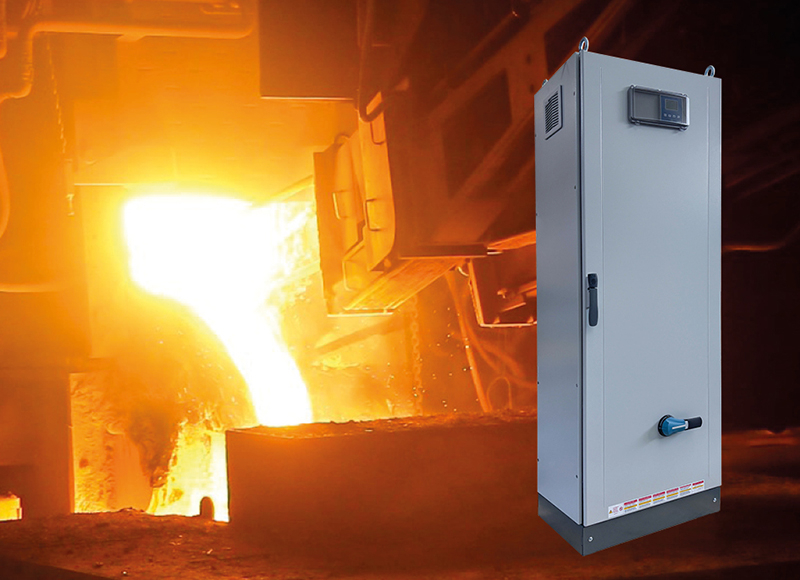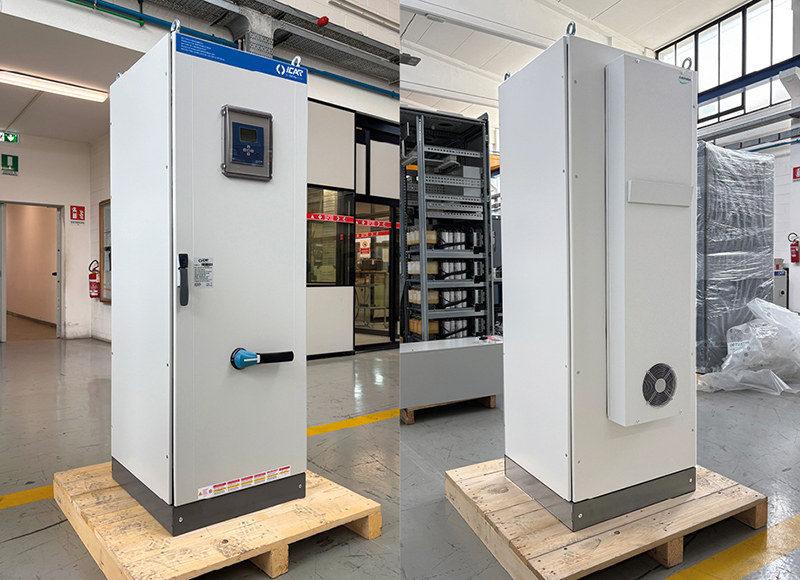



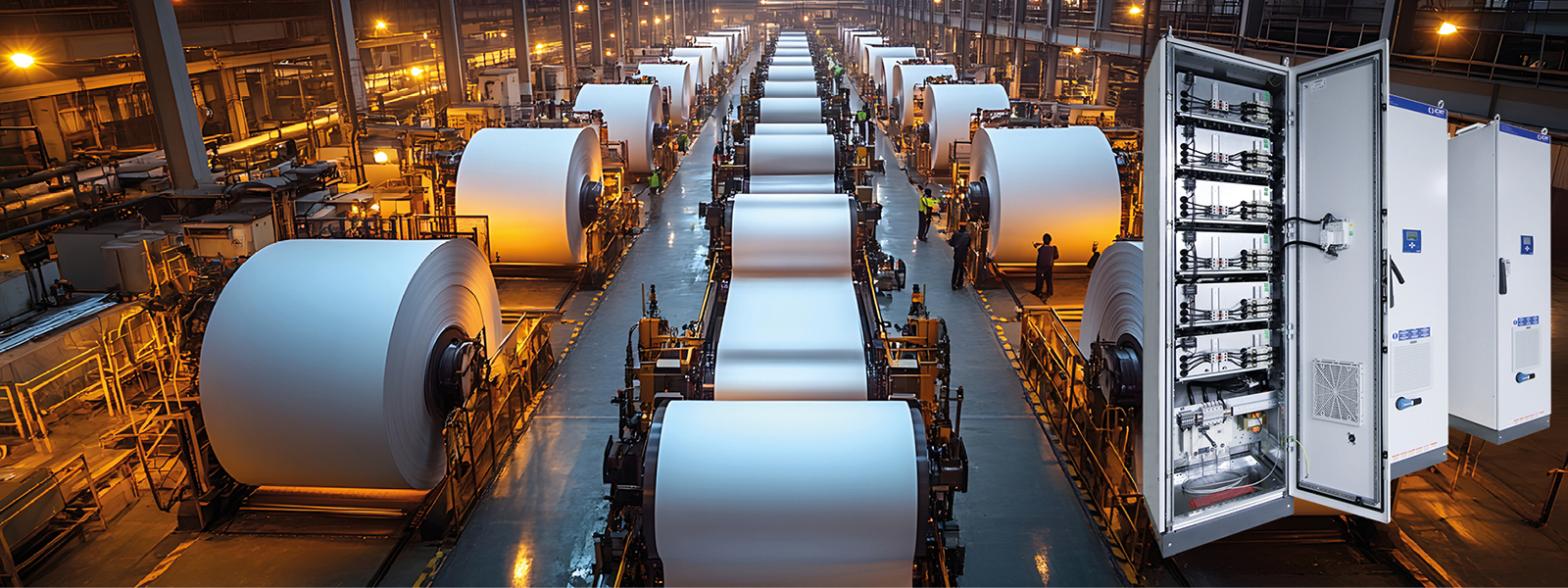
For an Italian group that is a leader in paper production, Ortea supplied a Multimatic FV automatic power factor correction system with detuned reactor. The system was custom-designed for industrial plants characterised by high harmonic distortion.
WHY PAPER MILLS GENERATE HIGH HARMONIC DISTORTION (AND HOW TO REDUCE IT)
In the papermaking process, numerous non-linear electrical loads coexist: asynchronous motors with inverters used in the forming, pressing and drying stages; vacuum pumps, fans and refiners controlled by VFDs; cutting or winding sections with fast dynamics and regeneration; switched-mode power supplies dedicated to auxiliaries such as lighting, IT/OT or UPS systems. These devices draw non-sinusoidal currents, which propagate through the internal network, causing a significant increase in current harmonic distortion (THD-I). The network impedance converts this distortion into voltage distortion (THD-V).
THE TYPICAL CONSEQUENCES OF HARMONIC DISTORTION INCLUDE
- overheating,
- nuisance tripping of protective devices,
- mechanical vibrations,
- higher losses and malfunctions in control systems.
Effective mitigation in LV switchboards requires a combined approach: automatic power factor correction to keep the cosφ within an optimal range, and detuned reactors that decouple the capacitors from the dominant harmonics. Correct selection of the tuning frequency, 135 Hz in this case, is essential to avoid resonance phenomena and ensure effective attenuation of the typical harmonics (5th, 7th, 11th) generated by 6/12-pulse VFDs.
THE SUPPLIED SOLUTION: MULTIMATIC FV, TUNED AT 135 Hz
Main technical data requested by the customer and supplier:
- Model: Multimatic FV35V (top-of-the-range power factor correction bank with barrier reactance).
- Operating voltage (Ue): 400 V
- Nominal bank voltage (Un): 550 V
- Frequency: 50 Hz.
- Tuning frequency: fD = 135 Hz (factor N = 2.7).
- Harmonic tolerance: THD-Ir% = 100%
- Harmonic tolerance: THD-Vr% ≤ 25% (suitable for operation even in networks with high voltage distortion).
- System objective: reduction of THD-V on the bus to ≤ 8% (design target value, depends on the harmonic spectrum and network impedance).
- Installed power: 640 kvar at 400 V.
Construction features and equipment supplied:
- Protection rating: IP4X; cable entry from below; dimensions 1830x675x2360 mm.
- Regulator: 8BGA (automatic step control) with on-board isolator and MCP5 accessory; auxiliary voltage 110 V.
- Permissible short-circuit current: 25 kA / 0.3″.
Technical note: the 135 Hz tuning decouples the capacitors from low harmonics (in particular 5th and 7th), prevents resonance phenomena and limits the harmonic current that would penetrate the bank, stabilising the power factor even in the presence of numerous VFDs and highly dynamic loads.
RESULTS ACHIEVED
The system has ensured a stable cosφ and a reduction in penalty charges on the electricity bill, even under partial-load conditions. The THD-V on the main busbar has been brought close to the target threshold (≤ 8%), with a consequent reduction in additional losses and overheating. Drives and sensitive equipment are now more reliable, with fewer unplanned plant stoppages. The switchboard is scalable and easy to maintain: automatic step regulation, diagnostics integrated into the regulator and IP4X construction suitable for harsh industrial environments.
ICAR’S EXPERIENCE IN POWER FACTOR CORRECTION
Ortea designs and manufactures tailor-made power factor correction systems using the know-how of the ICAR brand, present on the market for over 50 years. We offer solutions ranging from traditional configurations to banks with detuned reactors. We address the energy needs of energy-intensive sectors such as paper, steel, glass and chemicals. Our methodology includes customised sizing, careful selection of components (capacitors, reactors, protection devices) and optimisation based on the actual harmonic profile of the site. The goal is to ensure maximum operational continuity, high power quality and an optimised TCO (Total Cost of Ownership) over the entire life cycle of the plant.
FAQ
- Why choose tuning at 135 Hz in a paper mill?
Tuning at 135 Hz is an effective compromise: it decouples the capacitors from the 5th and 7th harmonics typical of VFDs and reduces the harmonic currents flowing into the bank, minimising the risk of resonance on the busbar. - Does power factor correction with reactor eliminate all harmonics?
The system reduces the propagation of low-order harmonics towards the capacitors and improves the voltage profile. For higher-order harmonics or extreme conditions, active filters or additional tuned stages can be considered. - Is it always possible to achieve THD-V ≤ 8%?
THD-V ≤ 8% is a realistic target, but it depends on the harmonic spectrum, network impedance and load power. Verification is carried out through pre- and post-installation measurement campaigns and fine-tuning. - What is the practical benefit for a paper mill?
Fewer alarms and plant stoppages, longer service life for cables, transformers and motors, and lower energy bills thanks to a corrected cosφ and reduced losses.