


In the industrial landscape of Southern Italy, production efficiency often has to contend with an invisible challenge: the quality and instability of the electrical grid.
At a manufacturing plant belonging to a leading company in the dried fruit sector, equipped with state-of-the-art Industry 4.0 production lines, mains microinterruptions had become a tangible problem for operational continuity. Even extremely short electrical events can in fact halt automated lines, block control systems and trigger sudden stoppages with immediate impacts on production.
To address this need, Ortea supplied a dedicated solution: an Oxygen Zero K microinterruption compensator rated at 1000 kVA, designed to maintain the power supply even in the event of voltage microinterruptions, with response times below 5 milliseconds.
WHAT ARE MICROINTERRUPTIONS AND WHY DO THEY POSE A REAL RISK
From a technical standpoint, a microinterruption occurs when the mains voltage drops by up to 100% of its nominal value for very brief periods (10-500 ms). It is precisely this brevity that makes them insidious: they are too rapid to be perceived as a traditional blackout, yet long enough to trip PLCs, drives, inverters, automation systems and supervisory logic.
The causes may vary:
- Local overloads: the high concentration of production plants generates load surges that affect voltage stability for nearby users.
- Atmospheric events and infrastructure: exposed overhead lines and switching operations on the distribution grid can cause sudden microinterruptions.
- Grid transients: switching operations performed by utility providers on medium and high voltage networks that propagate to the plant’s low voltage system.
In practice, the grid recovers very quickly, but that brief interval without voltage is enough to halt the production process.
GRID CRITICALITIES IN INDUSTRIAL AREAS
In a production context located within a large urban and industrial area, grid quality becomes a particularly sensitive issue. These problems rarely stem from a single cause; more often, they are multifactorial in origin.
In Southern Italy, structural and environmental factors frequently combine, making electrical grid quality especially critical for production facilities.
1. PARTIALLY OUTDATED DISTRIBUTION INFRASTRUCTURE
Sections of MT/BT grid that have been in service for decades accumulate transient faults, insulation losses and slower responses to load surges. Voltage drops along distribution feeders are more frequent compared with more recently built networks.
2. HIGH DENSITY OF HEAVY INDUSTRIAL LOADS
The presence of large production plants in the area, with high-absorption motors, compressors, industrial furnaces and variable frequency drives, generates current peaks and harmonic injections into the grid, resulting in widespread voltage fluctuations including microinterruptions.
3. SWITCHING OPERATIONS ON THE DISTRIBUTOR’S GRID
To manage faults, balance loads or isolate grid sections, the local distributor performs switching operations that generate transients and sudden voltage dips, often without prior warning.
4. ATMOSPHERIC PHENOMENA
Southern Italy is subject to intense thunderstorm events, particularly during the spring and autumn months. Lightning strikes and atmospheric discharges, even in the vicinity of the supply line, are a frequent cause of mains microinterruptions.
THE CRITICAL IMPACT OF MACHINE STOPPAGES IN THE FOOD SECTOR
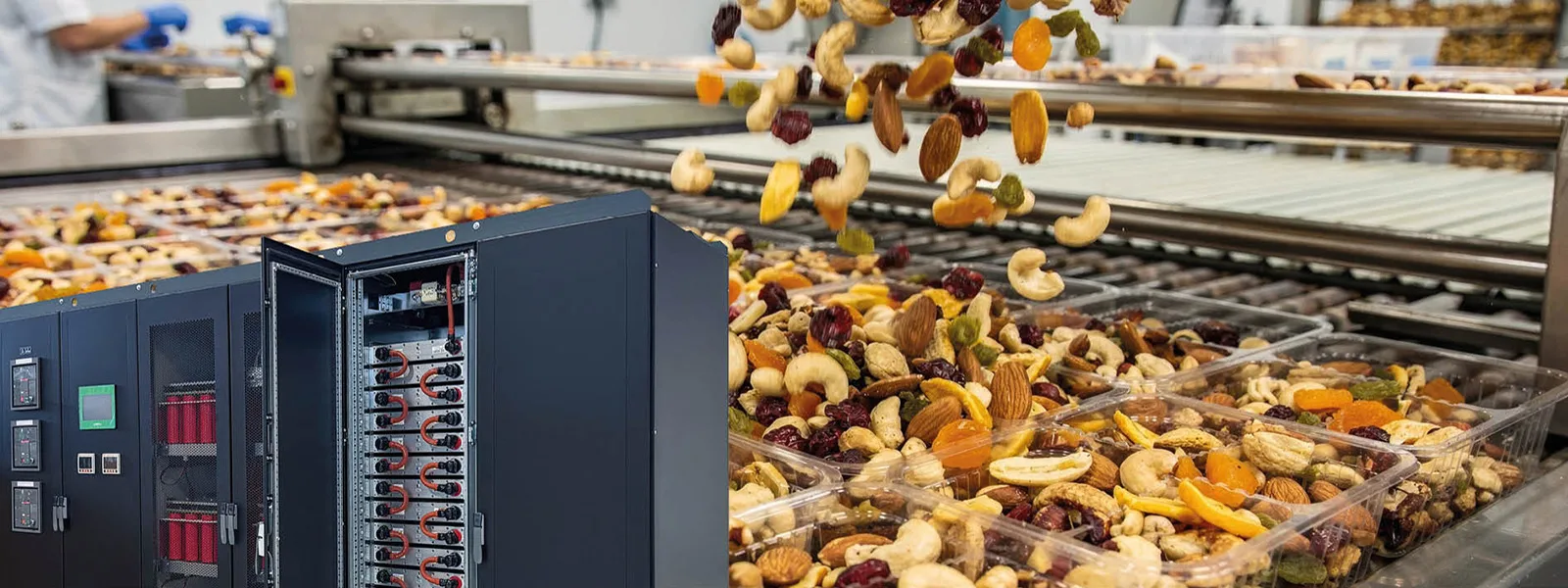
In the food sector, the damage caused by a microinterruption is not limited to line stoppages alone. A sudden halt can compromise the correct progression of transport, dosing, sorting, packaging and handling phases; it can generate waste, synchronisation anomalies, lengthy restarts, control system resets and a decline in overall efficiency.
When the process is continuous or highly automated, even a disturbance lasting a few milliseconds can translate into a cost far higher than the electrical interruption itself, directly affecting productivity and profitability.
THE PROPOSED SOLUTION: OXYGEN ZERO K
For this plant, Ortea proposed an Oxygen Zero K rated at 1000 kVA with the following main features:
- nominal power: 1000 kVA
- operating voltage: 400 V
- nominal output current: 1444 A
- efficiency above 99%
- voltage regulation with IGBT + supercapacitors
- output voltage accuracy ±0.5%
- tolerance to significant load imbalances
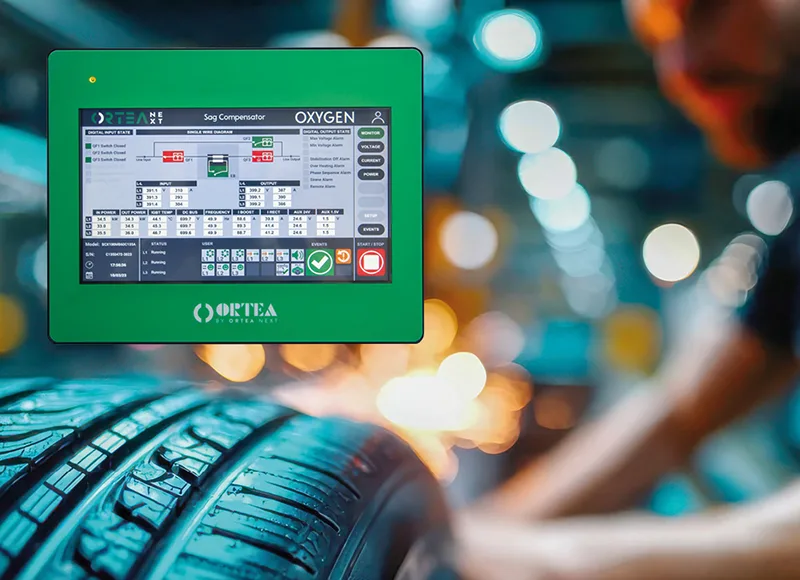
- 10″ multilingual touchscreen display
- MODBUS TCP/IP communication
- output surge arresters
The configuration provided ensures compensation for a total voltage loss (-100%) for 1 second, with correction time below 5 ms.
Furthermore, the K version supplied is equipped with a total protection kit featuring input switch, interlocked bypass and output switch.
HOW OXYGEN ZERO K WORKS
The system monitors the mains supply in real time; when it detects a complete loss of voltage, it intervenes almost instantaneously thanks to its IGBT and supercapacitor-based architecture, maintaining continuous power to the load. In this way, the production line remains unaffected by the disturbance.
AN INVESTMENT THAT PROTECTS PROCESS, QUALITY AND RELIABILITY
In cases like this, the value of the solution is not measured solely in electrical terms. Protecting a plant from microinterruptions means reducing unplanned stoppages, limiting waste, stabilising the production rhythm, and safeguarding both line efficiency and the quality of the finished product.
For a food company, it also means making timing, costs and service continuity more predictable, with benefits that extend across the entire industrial organisation.
WHY CHOOSE ORTEANEXT AS A POWER QUALITY PARTNER?
Choosing Ortea means selecting a partner that provides not only hardware, but complete engineering consultancy.
By integrating systems such as Oxygen Zero K, companies can:
- maximise OEE (Overall Equipment Effectiveness) by eliminating downtime
- monitor plant status through advanced communication systems (MODBUS TCP/IP communication protocol) and/or the XCloud platform for remote diagnostics
Ortea Next is the ideal partner for companies looking to address power quality and operational continuity challenges in a structured way. Drawing on consolidated experience in the industrial sector, specialised engineering know-how and a range of solutions designed for critical applications, Ortea Next supports its clients in improving plant reliability, reducing the risk of production downtime and increasing overall process efficiency.
Choosing Ortea Next means relying on a partner with specialist expertise in power quality, capable of supporting the company not only in supplying the most suitable solution, but also in analysing electrical criticalities and protecting production continuity. The experience gained in complex industrial environments, combined with a consultative approach and high-performance technologies such as Oxygen Zero K, makes it possible to address grid issues concretely, reducing plant stoppages, improving process reliability and contributing to more efficient management of the entire production system.
FAQ
WHAT IS A MAINS MICROINTERRUPTION?
A microinterruption is a total or near-total loss of voltage of very short duration, generally between 10 and 500 ms. Although it lasts only a fraction of a second, it can halt electronic systems and automated lines.
WHAT PROBLEMS CAN A MICROINTERRUPTION CAUSE IN A FOOD SECTOR PLANT?
It can cause line stoppages, product waste, control system resets, loss of synchronisation between machines, lengthy restart times and a decline in overall production efficiency.
DOES OXYGEN ZERO USE BATTERIES?
No. Oxygen Zero K uses an IGBT and supercapacitor topology, so it does not require batteries and reduces maintenance activities and costs compared with UPS systems.
WHY CHOOSE A MICROINTERRUPTION COMPENSATOR OVER OTHER SOLUTIONS?
Because it is a technology specifically designed to neutralise very brief but production-critical disturbances. In high-power, high-sensitivity applications, a dedicated compensator can prove more coherent than solutions originally designed for different needs.
IN WHICH INDUSTRIAL CONTEXTS IS IT PARTICULARLY USEFUL?
It is particularly useful in continuous processes, automated lines, departments featuring PLCs, drives and robotics, and more generally in any plant where even a few milliseconds without power can translate into production downtime.