



In the global industrial landscape, electrical power quality has become a critical factor for competitiveness. In environments where power quality and uninterrupted power supply are synonymous with efficiency and reliability, sag compensators play a key role, protecting processes from grid instability and ensuring operational continuity.
Continuity of electrical supply, in fact, is not merely a technical issue: it is a concrete lever for profitability, product quality and operational stability.
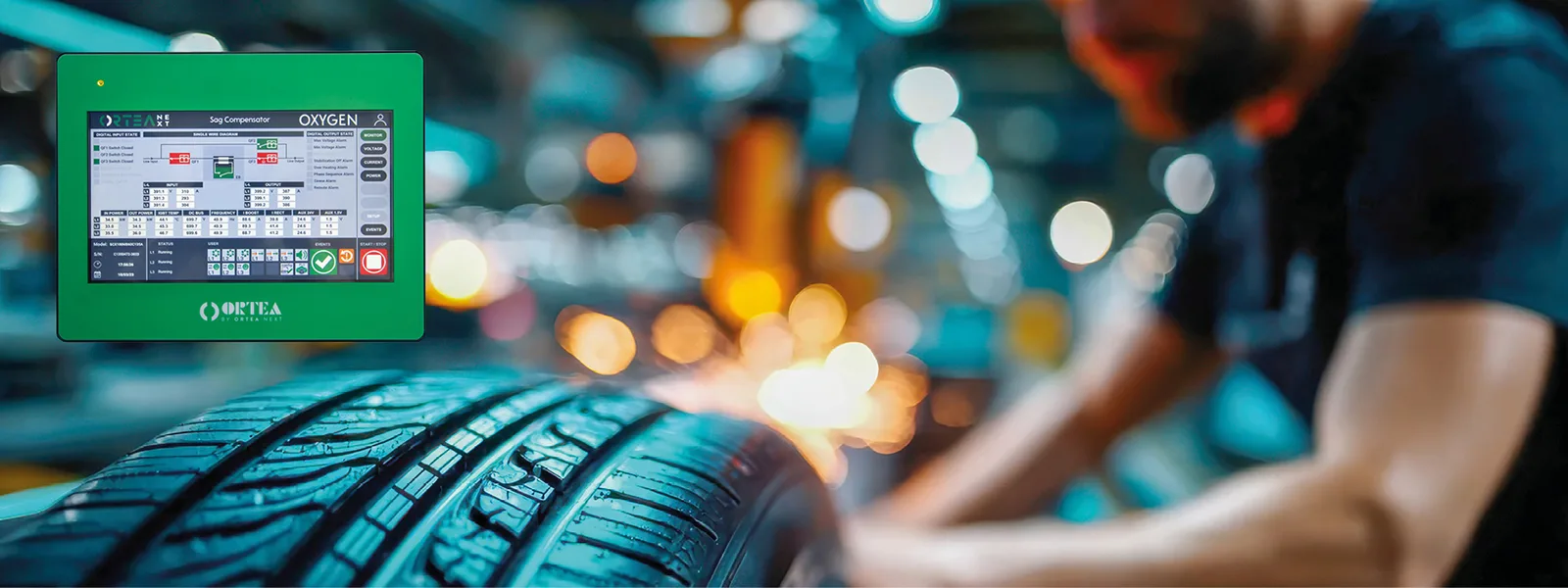
This issue becomes even more relevant in geographical areas where the electrical grid may be subject to instability and voltage variations. In this context, Ortea completed a strategic supply for a production plant belonging to a leading global tyre manufacturer located in South Africa, installing three voltage sag compensators from the Oxygen family, rated at 500 kVA, 800 kVA and 1000 kVA. The project represents a concrete response to the energy challenges of a complex geographical area and to the needs of a production process that does not allow interruptions.
SAG COMPENSATORS AND POWER QUALITY: THE SCENARIO IN SOUTH AFRICA
For many manufacturing businesses, especially continuous-cycle plants, the electrical infrastructure is as strategic as the production machinery itself. With this in mind, the installation of sag compensators directly addresses the need for a stable power supply, protecting sensitive equipment and ensuring operational continuity. When the grid is exposed to sudden variations, Power Quality stops being a specialist topic and becomes a management priority.
THE QUALITY OF THE ELECTRICAL GRID IN AFRICA: A REAL CHALLENGE FOR INDUSTRY
In many areas of the African continent, electrical grids may be subject to instability due to infrastructure under pressure, sudden load variations, weather events and critical issues in power distribution. For an industrial plant, this means not only the risk of total power interruptions, but also exposure to grid disturbances that can compromise the normal operation of production lines.
THE IMPACT OF GRID DISTURBANCES ON PRODUCTION AND EFFICIENCY
Among the most critical phenomena are voltage sags, which, even though they last only a few milliseconds, can cause major consequences:
- line stoppages;
- control system lock-ups;
- production scrap;
- efficiency losses.
In continuous and highly automated production contexts, the quality of the electrical supply therefore becomes an essential factor in ensuring operational continuity, process reliability and protection of the most sensitive equipment.
WHY TYRE MANUFACTURING IS SENSITIVE TO VOLTAGE SAGS
Tyre manufacturing is a continuous and highly integrated industrial process. From rubber compounding to extrusion and then vulcanisation, every stage is governed by sensitive electronic systems such as PLCs, inverters and sensors. In this type of environment, even a short-lived disturbance can interrupt process continuity and generate high operating costs.
PRODUCTION SCRAP AND MOULD DAMAGE
When a voltage sag occurs, the effects can be immediate. An extruder may stop suddenly, causing the rubber inside the machine to cool and solidify. In this case, the material becomes unusable and hours of technical cleaning are required before production can restart.
The vulcanisation phase is also particularly delicate. A voltage variation can compromise the thermal cycle, with the risk of damaging costly moulds and producing batches that do not comply with the required safety standards.
DOWNTIME AND RESTART COSTS
Every plant stoppage has an impact that goes beyond the simple momentary interruption. In a tyre factory, every stop requires a lengthy restart protocol. Lost time translates into lost production, reduced efficiency and increased operating costs. This is where power quality takes on concrete value in ROI terms, because preventing the disturbance means protecting the process and reducing the cost of downtime.
THE ORTEA SOLUTION: THREE OXYGEN UNITS TO PROTECT CRITICAL LOADS
To meet this need, Ortea supplied three Oxygen voltage sag compensators, selected for their reliability and technological precision. The installation was developed to protect the most critical sections of the production process selectively, following the actual distribution of loads within the plant. This approach is particularly effective when departments do not have the same absorption levels and do not show the same sensitivity to grid disturbances.
THE INSTALLED RATINGS: OXYGEN 500 KVA, 800 KVA AND 1000 KVA
The supply included the installation of three units:
- Oxygen 500 kVA
- Oxygen 800 kVA
- Oxygen 1000 kVA
The use of three systems with different ratings makes it possible to align protection with the real profile of critical loads distributed across the various departments, intervening where operational risk is greatest and optimising the production continuity of the entire site.
WHY OXYGEN? FEATURES AND TECHNICAL DIFFERENCES
Oxygen technology is designed specifically to protect industrial loads against deep and prolonged voltage sags. It is designed to intervene rapidly and precisely, ensuring stable voltage to the line even in the event of anomalies on the external grid. The installed models are in fact capable of compensating voltage sags of up to -50% of the nominal value.
NO BATTERIES
One of Oxygen’s main distinguishing features is the absence of batteries. This eliminates replacement costs, chemical disposal and many of the maintenance issues typical of other systems, especially in hot or demanding industrial environments.
EFFICIENCY AND RESPONSE TIME
Oxygen ensures efficiency of over 98% and a response time of less than 3 milliseconds, a duration that is imperceptible to the control electronics of machinery. This means that the production line continues to “see” stable and accurate voltage, without the negative effects associated with grid disturbances.
In addition, the technology uses double-conversion IGBTs and controls each phase independently to keep output voltage stable and accurate even in the most critical conditions.
FAQ ON VOLTAGE SAGS AND INDUSTRIAL POWER QUALITY
WHAT IS A VOLTAGE SAG?
It is a temporary reduction in voltage below the nominal value, typically between 10% and 90%, lasting from 10 milliseconds up to 1 minute.
WHY ARE VOLTAGE SAGS CRITICAL IN A TYRE FACTORY?
Because production consists of serial and highly automated phases. If a sag causes malfunctions in PLCs, drives or other controls during a critical stage, it can stop the line, generate scrap, compromise the curing cycle and lengthen restart times.
WHAT DISTINGUISHES OXYGEN FROM OTHER CONTINUITY SOLUTIONS?
Oxygen is specifically designed to compensate for voltage sags: it intervenes in less than 3 ms, operates without batteries, uses double-conversion IGBT technology and controls each phase independently to maintain stable and accurate output voltage.
IS MAINTENANCE COMPLEX?
No. As it is battery-free and based on a static electronic architecture, the system requires minimal maintenance, mainly limited to filter cleaning and fan inspection, with an extremely long service life.
WHY INSTALL THREE UNITS RATED AT 500, 800 AND 1000 KVA INSTEAD OF A SINGLE MACHINE?
Because in many industrial plants the critical loads are distributed across multiple switchboards or departments with different absorption levels. Using several ratings makes it possible to align protection with the real profile of the loads and intervene where operational risk is highest.
WHAT OPERATING BENEFITS CAN THE CUSTOMER EXPECT?
Greater process continuity, fewer unwanted stoppages, reduced scrap and reworking, less stress on electrical and electronic components, improved overall plant reliability and greater production stability in an environment exposed to Power Quality disturbances.


