


Efficiency doesn’t mean “cutting kWh at any cost”, but making loads operate at their optimal point and keeping the electrical network “lean”: correct voltage, adequate cosφ, harmonic distortion under control, fast events mitigated.
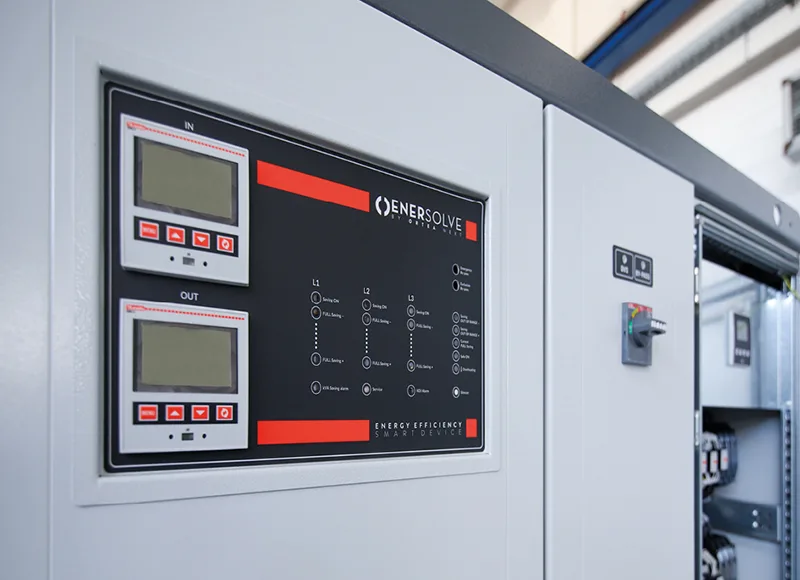
Ortea combines dynamic voltage optimisation (Enersolve, ComEC), power factor correction, active filters and XCloud remote monitoring to deliver a measurable outcome.
WHERE WASTE REALLY HIDES
In many plants, voltage is higher than necessary: motors run hotter, lighting consumes more, electronics are stressed. If the load mix includes inverters, LEDs and switching power supplies, harmonics appear: transformers and switchboards heat up, protections become “nervous”, and efficiency slips. A mediocre cosφ adds penalties and “fills” the network with reactive power, taking capacity away from active power that creates value. Finally, fast disturbances (sag, micro-interruptions) don’t inflate kWh, but they inflate costs: downtime, rework, scrap and OEE loss.
Project goal: bring voltage, waveform quality and power factor back to optimal values so you pay less and produce better.
DYNAMIC VOLTAGE OPTIMISATION (ENERSOLVE AND COMEC)
WHY START WITH VOLTAGE
Every load has a supply “window” where it performs best. Dynamic voltage optimisation targets that window: it reduces kWh, lowers thermal stress, and stabilises downstream network parameters.
ENERSOLVE (ESL-5/10/20)
Designed for industrial sites and complex tertiary environments:
- What it does: regulates voltage in real time, integrating by-pass and cloud telemetry (XCloud).
- Where it delivers: plants with variable profiles and mixed loads; multi-site operations needing consistent reporting.
- Why choose it: beyond savings, it extends load life and creates a measurable baseline for incentives and internal decisions.
COMEC (POWERSINES)
Same logic, SME/retail format:
- What it does: optimises voltage on feeders or subsystems (e.g., lighting).
- Where it delivers: shops, small/medium units with stable loads; savings up to ~12% in suitable scenarios.
- How to validate: a short measurement campaign, compare pre/post and verify stability across operating hours.
POWER FACTOR CORRECTION: CUT PENALTIES AND FREE UP CAPACITY
WHAT IT SOLVES (BEYOND “AVOIDING PENALTIES”)
Improving cosφ reduces reactive power, cuts charges and stabilises voltage drops on long lines. It also improves the utilisation of transformers and cables.
HP AND FH LINES: CHOOSING THE RIGHT CONFIGURATION
- HP: for networks with low THD.
- FH: when THD is high or there’s risk of resonance-use solutions with detuning reactors to protect capacitors and keep the system stable.
THE RULE: MEASURE THD FIRST
Selecting a power factor correction system without measuring THD and load behaviour is the quickest way to underperform. A measurement baseline avoids wrong sizing and makes results defendable.
ACTIVE FILTERS: WHEN HARMONICS EAT EFFICIENCY
Harmonics increase losses and temperatures, stress capacitors, and can trigger nuisance trips. An active filter measures distortion and injects the opposite current to cancel it in real time. Benefits typically include lower temperatures in transformers/switchboards, improved reliability and a cleaner network for sensitive loads.
FAST EVENTS: WHEN ENERGY EFFICIENCY ALSO MEANS CONTINUITY
Energy efficiency is not only kWh: a stop costs far more than any marginal saving. For sag and micro-interruptions on critical lines, the correct approach is fast event compensation (e.g., Oxygen/Zero, depending on the event type) integrated into the overall architecture.
HOW TO CALCULATE ROI (SIMPLE, AUDITABLE FORMULAS)
PAYBACK ON SAVINGS
- Annual savings (€) = (kWh saved × energy price) + avoided penalties + reduced losses
- Payback (years) = investment / annual savings
PAYBACK ON AVOIDED DOWNTIME
- Avoided downtime cost (€) = number of avoided events × average downtime (min) × cost/minute
- Total ROI improves when you add continuity benefits to pure kWh savings.
WHAT TO MEASURE (AND HOW)
Use a baseline with: voltage trend, THD, cosφ, energy consumption and (where possible) correlation with production KPIs. With cloud monitoring (XCloud), pre/post reporting becomes standard, not an exception.
TYPICAL SCENARIOS (WHAT WORKS IN PRACTICE)
SME/RETAIL
Stable loads, often overvoltage and a large lighting share: voltage optimisation on feeders delivers consistent savings; power factor correction depends on penalties and network profile.
MANUFACTURING WITH VARIABLE PROFILES
Mixed loads, more drives, greater variability: combine optimisation + power factor correction + active filtering based on measurements and add fast event compensation on critical lines if stops occur.
HEALTHCARE/DATA CENTRES
Optimised voltage + continuity on micro-interruptions (Zero) + upstream harmonic filtering to protect UPS/switchboards. Continuous reporting supports compliance and audits.
FAQ
HOW REALISTIC ARE THE SAVINGS?
It depends on overvoltage and the load profile. In SME/retail with stable loads, up to ~12% is achievable; in complex sites, estimates are more conservative but stable, confirmed by pre/post measurements.
DO YOU ALWAYS NEED POWER FACTOR CORRECTION?
If you pay penalties or the network is “saturated”, yes. With high THD use FH equipment with detuning reactors; with moderate THD, HP lines are often enough.
ANY CONFLICTS WITH PV/BESS?
No conflicts: an isolation transformer is often added, and the chain is correctly ordered as filter → power factor correction → optimisation, with optional stabilisation/compensation on critical sections.
HOW DO I PRESENT THE PROJECT TO THE BOARD?
With measured pre/post comparison, a business case including payback and TCO, and a preventive maintenance plan that protects the investment.
WHY ORTEA NEXT
An integrated portfolio (voltage optimisation, power factor correction, active filters, stabilisation/fast event compensation, transformers) and an engineering lead that starts from measurement, sizes correctly and monitors over time. Made in Italy manufacturing, global support network, and measurable ROI as a project standard.