



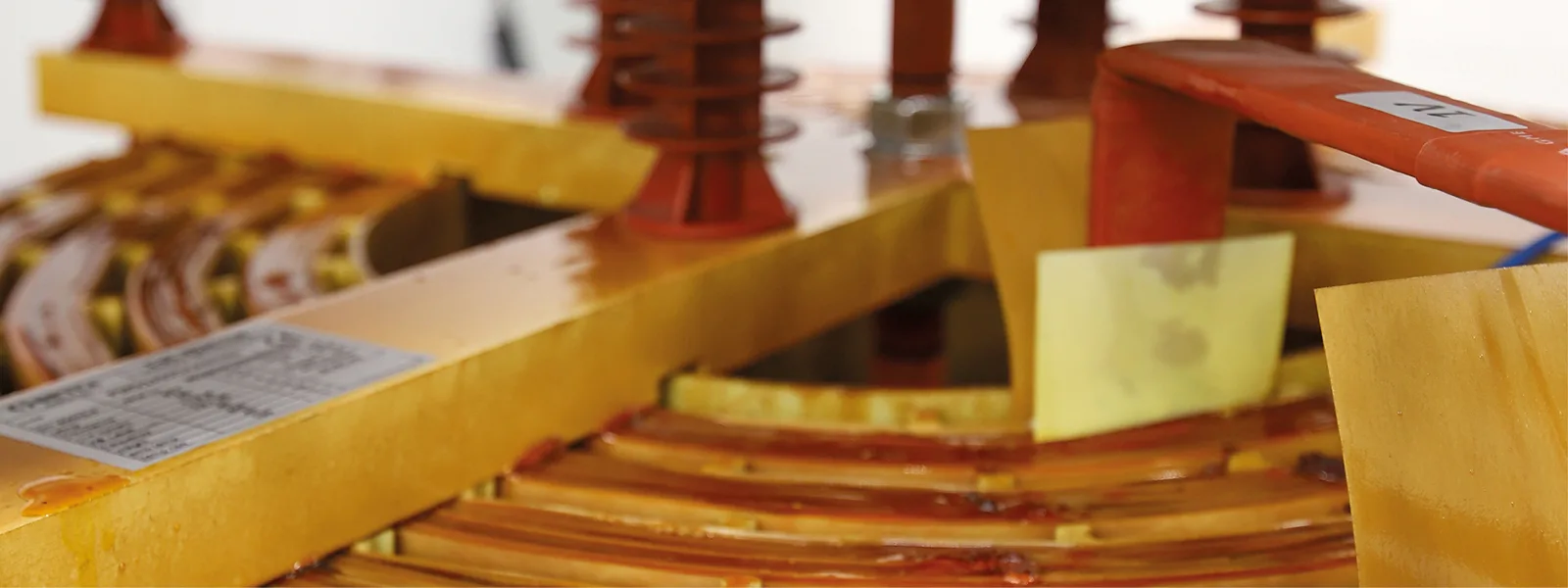
When a generation plant is connected to the distribution network (DSO), the short-circuit current that can flow towards the public grid in the event of a fault becomes a critical parameter for safety and power quality.
If the contribution from the customer’s generators is too high, the DSO protections may no longer be adequate, and the connection risks not being accepted or requiring costly reinforcements on the network side.
To solve this issue, Ortea has designed and built a fully customised medium-voltage current-limiting reactor, developed based on the customer’s technical specifications, the limits imposed by the DSO and the logistical constraints of the installation.
THE CUSTOMER’S CHALLENGE: LIMITING SHORT-CIRCUIT CONTRIBUTION TOWARDS THE DSO NETWORK
In this project, the customer operates several medium-voltage generation units connected to the public grid. Under fault conditions on the DSO network, the generators contribute to the short-circuit current to such an extent that the limits set by the network operator are exceeded.
The main objectives were:
- To reduce the short-circuit current flowing back into the public network, bringing it within the limits required by the DSO.
- To maintain adequate voltage levels and performance in normal operation, limiting voltage drop and losses during every day running.
- To comply with strict dimensional constraints for installation, dictated by the available space and on-site handling (access, clearances, lifting equipment).
From an electrical point of view, the chosen approach was to insert a line reactor in series between the customer’s generation units and the DSO network, sized with an inductance high enough to significantly reduce the fault current, without penalising the normal operation of the plant and the quality of the energy supplied.
WHAT IS A MEDIUM-VOLTAGE CURRENT-LIMITING REACTOR
A medium-voltage current-limiting reactor (or current limiting reactor) is a power inductor installed in series with the line, designed to control the level of short-circuit current seen by the network and by the connected equipment.
It is typically installed:
- between generators and the public grid;
- between different branches of a ring system;
- or upstream of sensitive loads.
Its main functions are:
- Limiting the short-circuit current seen by protections and downstream equipment.
- Enabling grid connection even when generators increase the short-circuit level beyond the permitted limits.
- Protecting circuit-breakers, busbars and cables, avoiding the need to oversize them.
Correct design requires a balance between:
- inductance value (and therefore level of short-circuit limitation);
- acceptable voltage drop in steady-state operation;
- losses, thermal behaviour and compliance with the applicable standards.
THE ORTEA SOLUTION: A CUSTOM REACTOR FOR MEDIUM-VOLTAGE APPLICATIONS
Based on the network data, generator characteristics and DSO limits, Ortea engineers developed a medium-voltage current-limiting reactor with the following main features:
- Rated reactor power: 181 kVA
- Rated voltage: 10 kV
- Rated current: 80 A
- Inductance: 30 mH
- Short-circuit impedance: 13 % @ 50 Hz
- Voltage drop at rated load: ~750 V
- Associated load power: 1400 kVA
The reactor is of air-core design with aluminum windings, a choice that ensures long-term stability of the characteristics, mechanical robustness and effective control of electrodynamic stress under fault conditions.
From the insulation point of view:
- Maximum operating voltage: 12 kV
- Power-frequency withstand voltage (1 min): 30 kV
- Lightning impulse withstand voltage (BIL): 75 kV
- Insulation and thermal class: H, with an admissible temperature rise of 125 °C
The reactor is VPI-impregnated (dry), suitable for indoor installation in IP00 execution, with environmental class E1-C1-F0 and a maximum operating altitude of 1000 m.
CUSTOM DESIGN: ELECTRICAL, THERMAL AND MECHANICAL CONSTRAINTS
Beyond the electromagnetic sizing, the design had to meet demanding constraints in terms of:
- Overall dimensions, to allow the reactor to be brought into and positioned within existing rooms without major civil works.
- Weight and lifting points, to simplify handling on site.
- Clearance distances and insulator layout, in compliance with EN 60076-6 for power reactors.
The reactor supplied by Ortea has overall dimensions of 1250 x 1250 x 1960 mm (W x D x H) and a weight of approximately 800 kg, values optimised to respect the site access limitations and the customer’s installation requirements.
The project required close cooperation between:
- the customer’s technical department, for the definition of network data, generator parameters and protection philosophy;
- Ortea specialists, who carried out the electrical and thermal design of the reactor, the assessment of losses (about 8.1 kW total AC+DC at 115 °C) and the mechanical design of the structure.
BENEFITS FOR THE CUSTOMER AND THE NETWORK OPERATOR
Thanks to the medium-voltage current-limiting reactor designed by Ortea, the customer obtains:
- Compliance with the DSO short-circuit limits, without the need to modify the public network infrastructure.
- Improved protection coordination, with fault currents within the intended setting range.
- Protection of equipment (circuit-breakers, switchgear, busbars) against excessive mechanical and thermal stresses.
- A solution perfectly integrated into the plant layout, thanks to full respect of dimensional and logistical constraints.
- Long-term reliability, supported by material selection, H-class insulation and the VPI impregnation process.
For the network operator, the presence of the reactor makes it possible to:
- limit the impact of the customer’s generation on the network short-circuit level;
- ensure correct operation and selectivity of protections;
- facilitate the integration of new distributed generation without compromising the safety of the existing infrastructure.
WHY CHOOSE ORTEA FOR CUSTOM SOLUTIONS
This project demonstrates Ortea’s ability to:
- start from complex system specifications (network data, generators, protections, DSO limits);
- translate them into a concrete electrotechnical solution, with a line reactor sized precisely for the required limitation level;
- engineer the equipment to measure also from a mechanical and logistical standpoint, in line with footprint and installation constraints.
Whether for medium-voltage current-limiting reactors, line reactors, filters or other special equipment, Ortea offers consolidated know-how in:
- electromagnetic and thermal design;
- performance verification under both normal and fault conditions;
- compliance with the relevant standards;
- mechanical and plant customisation.
All this within a comprehensive portfolio of solutions for power quality and energy efficiency, fully designed and manufactured in Italy and supported by an international network of specialists.
FAQ ON SHORT-CIRCUIT CURRENT LIMITATION IN MEDIUM VOLTAGE
WHY IS A CURRENT-LIMITING REACTOR NEEDED WHEN GENERATORS ARE CONNECTED TO THE GRID?
When a generation plant is connected to the DSO network, the generators contribute to the short-circuit current in the event of a fault. If this contribution exceeds the limits allowed by the operator, the protections and network equipment may no longer be adequate. A medium-voltage current-limiting reactor reduces the fault current to a level compatible with the DSO specifications and enables safe connection of the plant to the grid.
HOW IS A MEDIUM-VOLTAGE CURRENT-LIMITING REACTOR SIZED?
Sizing starts from the network data, generator characteristics and short-circuit limits imposed by the DSO. The required inductance value is defined to reduce the fault current, while at the same time checking voltage drop and losses in normal operation. Ortea also performs thermal and mechanical verification to ensure reliability, service life and compliance with the applicable standards.
WHAT ARE THE ADVANTAGES OF A CURRENT-LIMITING REACTOR COMPARED WITH SIMPLY UPGRADING EQUIPMENT RATINGS?
Without a reactor, the only alternative may be to oversize circuit-breakers, busbars and switchgear, with very high costs and possible structural modifications to the plant. A current-limiting reactor keeps the short-circuit current within values that can be handled by existing equipment or standard devices, simplifying protection coordination and reducing the overall investment.
HOW DOES ORTEA TAILOR MEDIUM-VOLTAGE REACTORS TO CUSTOMER REQUIREMENTS?
Ortea designs medium-voltage reactors starting from the electrical specifications (voltage, current, inductance, short-circuit impedance) and plant constraints (dimensions, weight, installation method, connection layout). Materials, insulation class, cooling system and mechanical configuration are all customised, providing a bespoke solution that integrates perfectly into the customer’s plant and supports their energy-efficiency and reliability objectives.