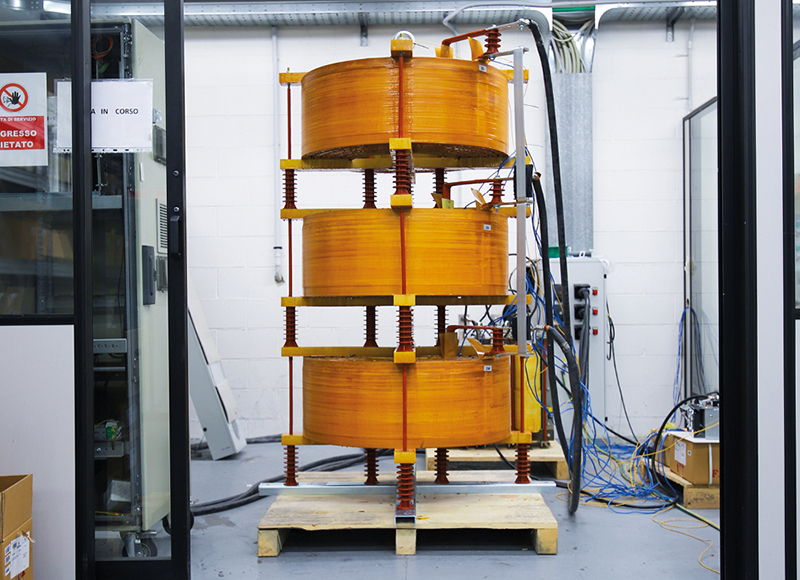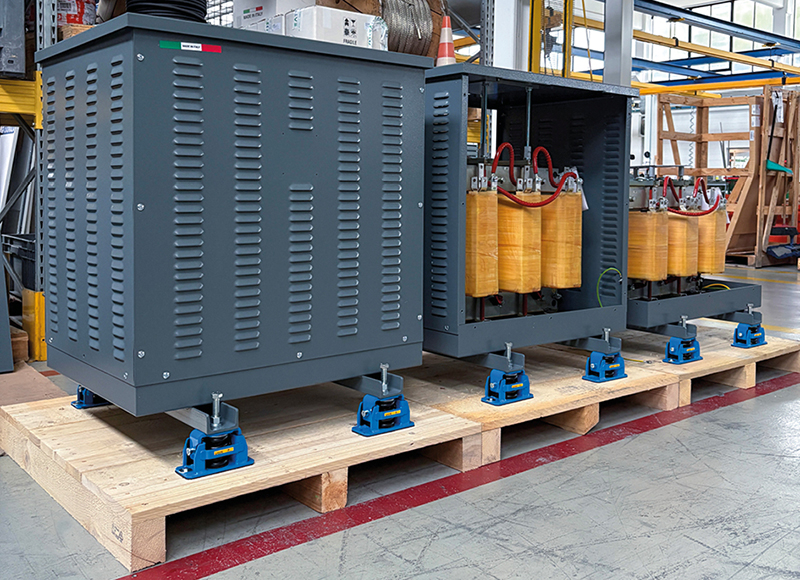




For the power supply systems of several critical sites of the Milano Cortina 2026 Olympic Games, as part of a dedicated power quality project, a global electrification and automation multinational chose Ortea to supply ten enclosed isolation transformers to be installed between the grid and the UPS systems serving sensitive loads.
These power systems are built in prefabricated containers integrating all the necessary equipment (switchgear, UPS, transformers, protection and control systems) to ensure continuity and quality of energy in a scenario with extremely high international visibility. In an Olympic context, where broadcast infrastructure, IT, security, lighting and management systems must operate without interruption, any network disturbance is simply unacceptable.
POWER QUALITY ISSUES INTRODUCED BY UPS SYSTEMS
UPS units are essential to guarantee service continuity, but in terms of power quality they behave as non-linear electronic loads, with some typical critical aspects:
- Current harmonics
UPS rectifiers and inverters draw highly distorted current. This increases current THD, can distort the voltage waveform and, in extreme cases, cause overheating in cables, transformers and switchgear. - Overloading of the neutral conductor
Triplen harmonics (3rd, 9th, 15th, …) tend to add up in the neutral, generating high currents even when the loads appear to be balanced. Without proper decoupling, this can lead to overheating and premature ageing of components. - Low power factor and peak currents
Depending on the technology, UPS systems may exhibit a non-optimised power factor, draw significant peak currents and generate switching transients (for example during mains/battery transfers or static bypass operation), with possible disturbances upstream. - High-frequency and common-mode disturbances
Power electronic switches (IGBTs) generate high-frequency noise and common-mode disturbances that propagate towards the network. These can interfere with automation, measurement, communication and protection systems.
BENEFITS OF A TRANSFORMER BETWEEN GRID AND UPS
Installing a dedicated, correctly sized isolation transformer (including K-Factor rating) between the grid and the UPS makes it possible to:
- galvanically decouple the line from the power electronics;
- filter a significant share of common-mode disturbances;
- correctly redistribute harmonic currents and neutral currents;
- reduce thermal and dielectric stress on other components of the installation.
In high-criticality applications this level of protection is essential to avoid plant outages and service disruptions during the event.
FEATURES OF THE ISOLATION TRANSFORMERS SUPPLIED BY ORTEA
The transformers supplied by Ortea are 275 kVA, 50 Hz units, with 400 V primary and 408 V Dyn11 secondary, K-Factor 4, IP21 enclosure, electrostatic screen between primary and secondary and insulation class H, designed to operate in environments up to 40 °C with high efficiency (98%).
Installed between the line and the UPS, these isolation transformers play a key role: they protect the network and upstream equipment from the distortion and disturbances typical of power electronic loads, helping to keep power quality stable under all operating conditions, especially in containerised, multi-site configurations such as those of Cortina 2026.
ORTEA: RELIABILITY RECOGNISED BY MAJOR INTERNATIONAL PLAYERS
This supply confirms Ortea’s ability to work alongside major global system integrators, designing and manufacturing specification-based isolation transformers from both an electrical and a mechanical perspective.
The transformers were configured to meet stringent requirements in terms of:
- rated power and K-Factor suitable for the presence of harmonics;
- voltages and connections (Delta/Star with neutral) optimised for integration with the UPS systems and the customer’s network;
- degree of protection and cabinet finish for installation in prefabricated containers;
- high efficiency and low losses to reduce operating costs and simplify thermal management within the container.
Being selected for a project linked to a global event such as the Milano Cortina 2026 Olympic Games, and for the most sensitive power quality Cortina 2026 sites, means that reliability, build quality, technical expertise and on-time delivery have all been carefully assessed and rewarded.
For professionals in the electrical and automation sectors, Ortea is a partner able to:
- analyse load profiles and plant constraints;
- propose transformation and filtering solutions focused on power quality;
- provide technical support throughout the entire lifecycle of the equipment.
FAQ: ISSUES CAUSED BY UPS SYSTEMS WITHOUT ISOLATION TRANSFORMERS
- What risks are associated with connecting a UPS to the grid without an isolation transformer?
The UPS injects current harmonics, switching disturbances and high-frequency noise directly into the upstream network. Over time this can cause overheating of cables and transformers, nuisance tripping of protection devices and degradation of sensitive equipment connected to the same network, with even greater risks in mission critical contexts such as power quality at Cortina 2026. - Can a UPS without an isolation transformer reduce the service life of plant components?
The continuous presence of harmonic currents and voltage transients increases thermal and electrical stress on transformers, circuit-breakers, switchgear and cables. This accelerates insulation ageing and raises the probability of faults and unplanned outages. - Why is the absence of an isolation transformer critical at sites with sensitive loads?
Where IT, telecom, automation, security or measurement systems are present, disturbances generated by UPS units can cause malfunctions, unexpected resets, communication errors and interference on analogue signals. The isolation transformer helps create a “separation layer” between a disturbed network and sensitive loads. - Are the filters built into the UPS not sufficient to protect the upstream network?
Filters integrated in UPS systems reduce part of the harmonics, but often do not eliminate their impact on the network, especially in the presence of multiple UPS units in parallel or strongly non-linear loads downstream. An external isolation transformer, correctly sized and equipped with an electrostatic screen, adds an extra level of protection and makes the overall system more robust from a power quality point of view.