



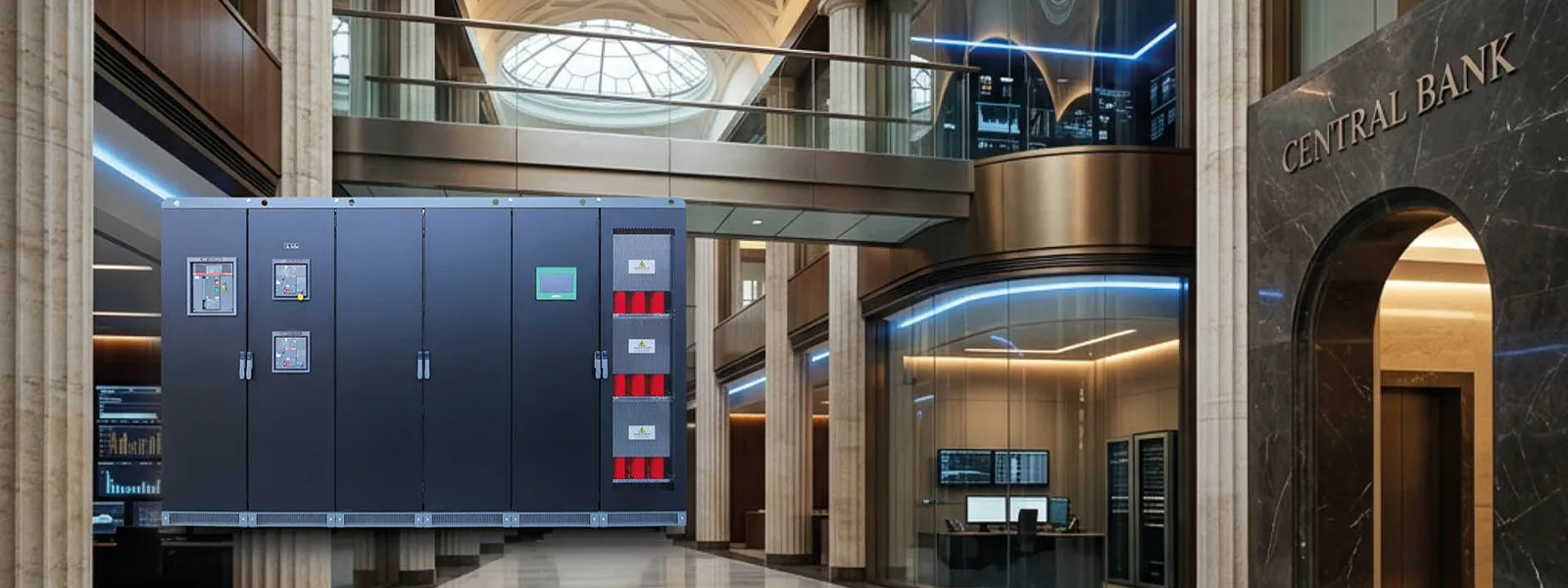
In geographical contexts characterised by an unstable power grid, power quality becomes a decisive factor in ensuring the operational continuity of critical infrastructure, such as banking institutions.
For this reason, voltage stabilisation is not just an electrical protection measure, but a strategic choice to preserve reliability, security and service continuity.
Recently, a leading banking institution located in North Africa turned to Ortea to solve a complex challenge: protecting its infrastructure from a highly unstable local power grid subject to frequent and dangerous voltage fluctuations.
WHY VOLTAGE STABILITY IS ESSENTIAL FOR A BANK
Banks depend on complex technological systems: data centres, servers, security equipment, access control systems, communication networks, ATMs, HVAC systems and sensitive electronic devices.
Even minimal voltage variations can cause IT system malfunctions, generate errors in electronic devices, reduce equipment lifespan and increase the risk of operational downtime.
In this context, even brief interruptions or anomalies can have a significant impact on service continuity, data security and user experience.
THE TAILOR-MADE SOLUTION: STATIC TECHNOLOGY
To meet this need, Ortea supplied three top-of-the-range electronic (static) voltage stabilisers from the Odyssey series, designed for indoor installation and configured to offer the highest level of protection:
- 1x Odyssey 1000 kVA: featuring 400V input and output voltage, a ±15% input range and an integrated 3xMCCB bypass kit.
- 2x Odyssey 500 kVA: also with 400V voltage (input/output), ±15% input range and 3xMCCB bypass kit.
The real strength of these systems lies in the output accuracy: both models guarantee an output stabilisation accuracy of ±0.5%, an indispensable value for the sensitive electronics of a large bank.
STATIC VS. ELECTROMECHANICAL STABILISERS: WHICH SOLUTION TO CHOOSE?
Voltage stabilisers can be manufactured using different technologies. Among the most widespread solutions are electromechanical stabilisers and electronic (static) stabilisers. Both aim to correct mains voltage variations, but they do so using different systems.
But why was static (electronic) technology preferred over electromechanical for this critical infrastructure? Let’s analyse the technological differences to understand how to guide the choice depending on the geo-electrical context.
ELECTROMECHANICAL VOLTAGE STABILISERS
This technology is based on a buck/boost transformer and an electronically controlled voltage regulator. Based on a microprocessor that samples the output voltage at high frequency, the control system drives the regulator motors and consequently the voltage supplied to the primary of the booster transformer.
- High overload tolerance: they handle high current inrushes and symmetrical overloads very well.
- Linear regulation: excellent accuracy over more gradual and constant mains variations over time.
- Ideal for: large industrial plants, electric motors, factory production lines and applications where the required response times are in the order of seconds rather than milliseconds.
ELECTRONIC (STATIC) VOLTAGE STABILISERS
A static voltage stabiliser consists of a buck/boost transformer and an IGBT-based conversion unit that manages regulation, control, measurement and alarms. The operating principle is similar to that described for electromechanical stabilisers, with the difference that the voltage compensation on the primary winding of the buck/boost transformer is performed by an electronic board via static IGBT switches.
Static stabilisers regulate voltage digitally via semiconductors (thyristors).
- Response speed: they correct the voltage in just a few milliseconds (typically < 20 ms).
- No moving parts: as there are no mechanical components subject to wear, maintenance is virtually zero.
- Ideal for: critical infrastructure, banking data centres, medical equipment and wherever fluctuations are sudden, severe and unpredictable.
In short, there is no absolute “best” technology: there is the most suitable technology for the grid type, the load to be protected and the level of continuity required.
Electronic static technology is the mandatory choice when, as in this case, the priority is instantaneous intervention speed.
ORTEA NEXT: GLOBAL PARTNER
The choice to rely on Ortea for securing such a prominent financial institution is no coincidence. For decades, Ortea Next has been synonymous with excellence and reliability in the design of advanced power quality solutions.
Every project requires a careful analysis of grid conditions, load characteristics and operational continuity objectives. This is why Ortea develops tailor-made solutions capable of meeting the needs of complex contexts, from industry to critical infrastructure, up to public and financial bodies.
This supply represents a further example of Ortea’s ability to support international clients with reliable, precise solutions designed to ensure maximum continuity even in the presence of unstable power grids.
FAQ
WHY DOES A BANK NEED VOLTAGE STABILISERS?
A bank uses electronic, IT and security systems that require a stable power supply. Voltage variations can cause malfunctions, service interruptions or premature equipment wear.
WHAT IS THE DIFFERCTION BETWEEN A STATIC AND AN ELECTROMECHANICAL STABILISER?
A static stabiliser uses power electronic components and offers a very fast response. An electromechanical stabiliser uses a servomotor system and is suitable for slower, more progressive voltage variations.
WHEN IS IT BEST TO CHOOSE A STATIC STABILISER?
It is best to choose a static stabiliser when sensitive loads, rapid grid variations or high operational continuity requirements are present, such as in banks, data centres, hospitals and critical infrastructure.
WHEN IS IT BEST TO CHOOSE AN ELECTROMECHANICAL STABILISER?
An electromechanical stabiliser is suitable for many industrial applications where voltage variations are slower and where a robust, reliable and efficient solution is required.


