

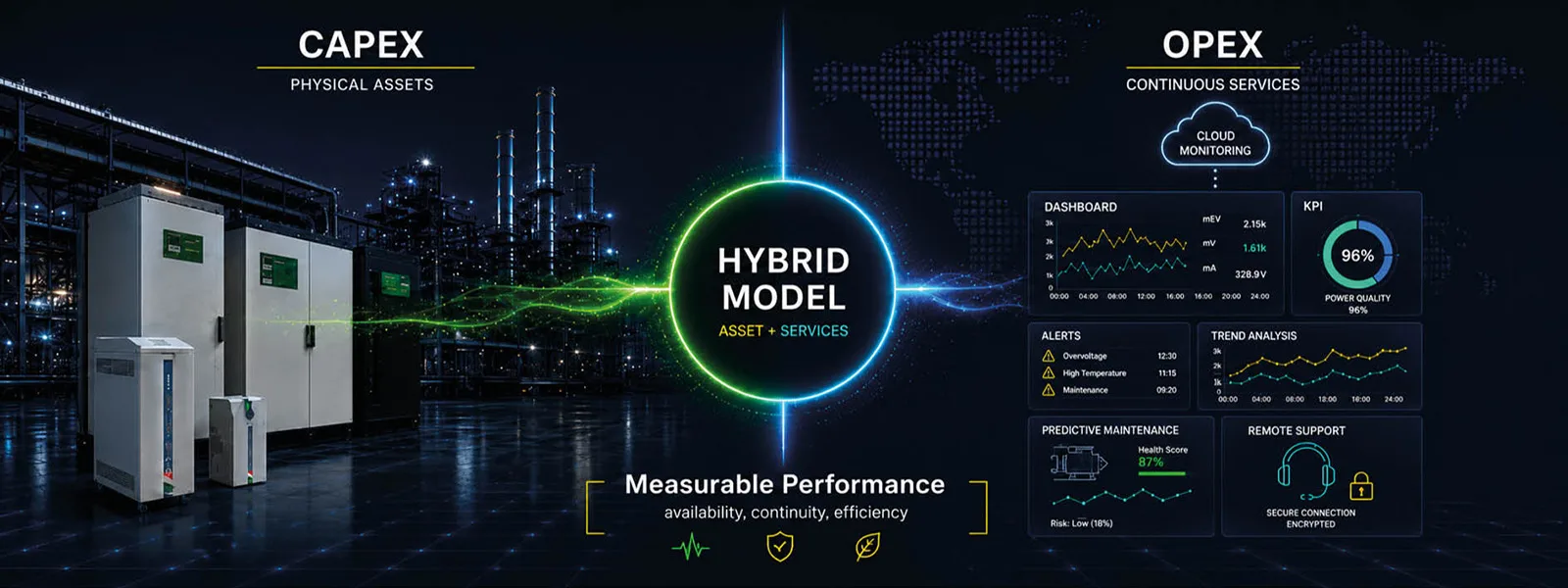
When talking about industrial energy efficiency linked to power quality, Capex and Opex are two different ways of keeping the same objective under control: electrical stability, process continuity and measurable results over time. In this area, installing a device is not enough: network and load conditions change, production lines evolve, and real value is created when technology and management work together.
For this reason, in industrial practice the choice is almost never Capex or Opex, but Capex + Opex, i.e. a hybrid model:
- Capex refers to the assets that act on power quality and efficiency (voltage stabilisation, compensation, power factor correction, filtering, etc.).
- Opex refers to the services that protect performance and ROI: monitoring, alarms, maintenance and assistance.
Ortea’s approach offers an integrated solution that supports the customer at every stage: from requirements analysis and selection of the ideal equipment to installation, after-sales assistance and remote monitoring through the Ortea XCloud platform.
BEYOND THE CAPEX VS OPEX DILEMMA: WHY YOU DO NOT HAVE TO CHOOSE ONE OR THE OTHER
IN INDUSTRY, SUPPLY IS ALMOST ALWAYS HYBRID (SYSTEM + MANAGEMENT)
In industry, a power quality and energy efficiency project is rarely limited to the purchase alone: to be manageable, it must include a system (physical asset) and management (services). This is especially true when the goal is not only to reduce consumption, but also to limit operational impacts such as production interruptions, equipment stress or grid instability.
In very practical terms:
- Capex (assets): the equipment you install to correct or prevent electrical phenomena (voltage variations, micro-interruptions and voltage sags, reactive power/cosφ, harmonics, etc.).
- Opex (services): everything that ensures the asset continues to work as expected, with data, alarms, maintenance and traceability of results (monitoring, assistance, preventive maintenance and support).
This is why the right question is: what mix of assets and services is needed to achieve technical and economic KPIs with a sustainable risk profile?
WHERE VALUE IS CREATED: MEASURABLE RESULTS AND OPERATIONAL CONTINUITY
In power quality, the value of a project is not the technology itself, but the measurable effect on the process. This is why the “assets + services” approach is so widespread:
- the asset acts on the physical/electrical cause (correction, protection, compensation);
- the services make results continuously measurable, enable faster diagnostics and help maintain optimal performance throughout the life cycle.
Ortea explicitly positions support services (preventive maintenance, assistance including remote support, remote monitoring, spare parts, document support) as a lever for uptime, reliability and alignment with requirements.
ORTEA’S “HYBRID” MODEL
CAPEX: TECHNOLOGIES AND ASSETS FOR POWER QUALITY AND EFFICIENCY
In the hybrid model, Capex represents the equipment and systems that become part of the plant.
Ortea has an integrated portfolio that addresses the main challenges in power quality and energy efficiency: voltage stabilisers, compensators for micro-interruptions and voltage sags, power factor correction systems, active filters and voltage optimisers.
- Voltage stabilisation: a complete range for every need.
- Continuity against micro-interruptions and voltage sags: Oxygen and Oxygen Zero equipment.
- Energy saving: Enersolve is an intelligent energy efficiency device with cloud monitoring.
- Power factor correction: systems and components dedicated to reactive power/cosφ
- Harmonic filtering: active filters such as ACTIVEmatic and VARYX filter are part of the power quality portfolio.
OPEX: SERVICES THAT PROTECT PERFORMANCE AND ROI (MONITORING, ALARMS, MAINTENANCE, ANOMALY ANALYSIS)
The Opex component turns the investment into a sustainable asset for Operations and a solid one for the CFO, thanks to recurring services that ensure operational continuity and consistent performance over time.
- Scheduled preventive maintenance, for optimal performance and reduced failures.
- After-sales assistance, including remote support.
- Cloud remote monitoring through Ortea XCloud to control electrical parameters, consumption and alarms in real time.
- Repair, reconditioning and original spare parts throughout the entire life cycle.
WHY OPEX, UNDERSTOOD AS SERVICES, REDUCES RISKS AND INDIRECT COSTS
Opex is not an additional cost: it is often what prevents Capex from becoming an uncontrolled investment. In a real plant, indirect costs come from:
- plant downtime, even short but repeated events;
- reactive interventions and slow diagnostics;
- stress and wear on equipment;
- lack of traceability when results and priorities need to be justified.
Services such as monitoring, preventive maintenance and rapid assistance reduce these risks by improving uptime and reliability.
THE BUSINESS CASE THAT CONVINCES CFO AND OPERATIONS
ECONOMIC KPIs
In a power quality/efficiency project, economic KPIs only work if they are linked to an “assets + services” logic. The point is to build a credible TCO by including:
- asset cost (Capex) + service cost (Opex);
- operating costs linked to continuity and maintenance;
- indirect impacts that the organisation wants to reduce, such as events and discontinuities that degrade productivity.
OPERATIONAL KPIs
For those who manage Operations, the most significant KPIs are those linked to infrastructure efficiency and process operational continuity, for example:
- power quality: events, repetitions, instability, distortions;
- continuity: time in anomaly, events impacting production lines;
- grid indicators: cosφ/reactive power and related quantities;
- power: peaks and profiles, when relevant to the use case.
MEASUREMENT AND VERIFICATION
This is where Capex and Opex become essential: measurability is what makes the hybrid model approvable. To turn estimates into concrete data-based evidence, an efficient plant must be based on three elements:
- Baseline: define what “normal” means before the intervention, in terms of period, operating conditions and loads.
- Continuous M&V: measure not just once, but over time, to capture trends and variations.
- Traceability: data, reports and history useful both for maintenance and for the business case and documentation.
OPEX, CAPEX OR HYBRID: DECISION CHECKLIST
- Does the project arise from a power quality problem, an efficiency objective, or both?
- Which part is Capex (installed assets) and which part is Opex (recurring services) within the scope you are evaluating?
- Do you have a measurable baseline before the intervention, with a defined period and operating conditions?
- Which operational KPIs must be protected (continuity, process quality, sensitive equipment)?
- Do you only need a one-off check or continuous M&V with history and reports?
- Are workflows and responsibilities for alarms and interventions defined (who sees what, when, and with what priority)?
- Is the main cost in kWh or in indirect costs (downtime, scrap, reactive maintenance)?
- Single-site or multi-site scenario: is standardisation and a centralised view required (dashboard + alerts)?
- Are there documentation requirements for incentives (data, traceability, measurable evidence)?
- Which Opex services are essential to make ROI convenient over the life cycle (maintenance, remote monitoring, assistance)?
FAQ
WHY DO CAPEX AND OPEX GO TOGETHER IN INDUSTRIAL PROJECTS?
Because in power quality, Capex installs the asset that acts on the electrical phenomenon, while Opex (remote monitoring, maintenance, assistance and M&V) maintains performance and makes results measurable and traceable over time.
HOW CAN SAVINGS BE DEMONSTRATED CONTINUOUSLY?
With a defined baseline and a Measurement & Verification process: continuous measurements, data history, alerts and reports, also through cloud remote monitoring, so that estimates become evidence.
WHAT CHANGES IF THE OBJECTIVE IS TO REDUCE DOWNTIME AND FAILURES, NOT ONLY CONSUMPTION?
The priority KPIs change: continuity and power quality become central (events, instability, repetitions), and Opex services that speed up diagnosis and intervention become crucial, reducing indirect costs.