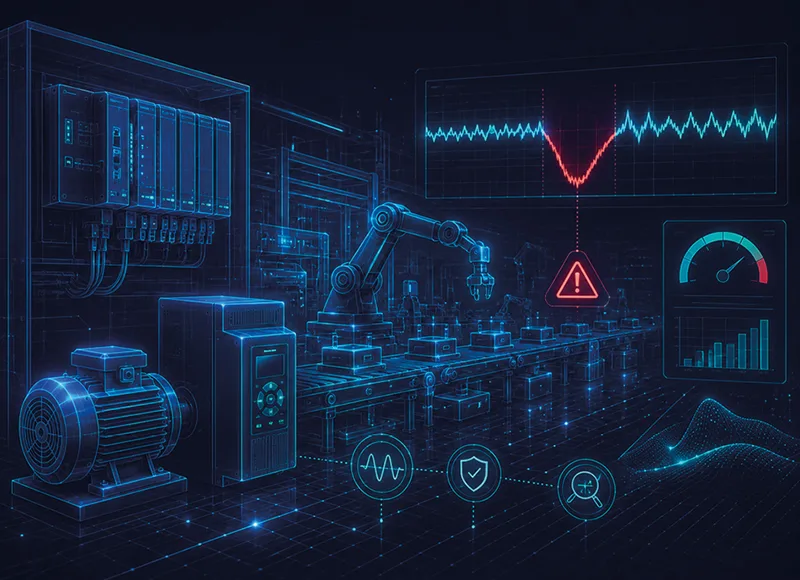




At 06:45 the extrusion line is already up to temperature. A voltage dip lasting just a few milliseconds makes an inverter lose synchronisation; the PLC trips into fault, and the SCADA reports “safety stop”. In the switchboard room nobody has seen a real blackout – and yet the shift stops, the plastic cools in the die, and rework is needed.
That is a voltage sag: it doesn’t last long, but it costs a lot.
At the other end of the plant, the LED lighting flickers slightly: it doesn’t ruin anyone’s day, but it’s a sign that harmonics and “high” voltage are pushing everything above its optimal operating point. Meanwhile, the bill shows a steady line of cosφ penalty charges.
THIS IS WHERE – IN THE SUM OF ELECTRICAL DETAILS AND MAN–MACHINE TIME – POWER QUALITY HITS OPEX AND PRODUCTIVITY.
HOW THE PROBLEM SHOWS UP
HIGH-SPEED BOTTLING LINE
A sag during the pick-and-place phase is enough to trigger a cascade of alarms: drives go into protection, encoders lose their reference, vision systems reboot. The line restarts, but the batch that has just been labelled ends up as scrap because it is non-compliant. A sag compensator installed downstream of the substation, set to intervene within a few milliseconds, “rides through” the event so it never reaches the control logic. (Oxygen range, response <3 ms, up to 2500 kVA; for repeated micro-interruptions, Oxygen Zero with supercapacitors, <5 ms, 500-1500 kVA).
EXTRUSION / INJECTION MOULDING DEPARTMENT
The compound is perfect, but the actual voltage at the machine end is higher than needed. Motors and heaters run hotter than necessary, kWh consumption rises, and the electronics operate under strain.
A dynamic voltage optimisation system brings the supply back into the loads’ efficient window: consumption, thermal peaks and defects are reduced, with cloud monitoring to measure before/after. (Enersolve and ComEC solutions, with savings up to ~12% in suitable scenarios.)
PAPER / TEXTILE WITH WIDESPREAD INVERTERS
Productivity drops “once hot”: transformers and LV switchboards feel warmer than usual, and some protections trip with no obvious fault. Here harmonics from non-linear loads are the culprit: the current is “dirty”, it introduces losses, heats components and confuses protective devices.
An active filter cancels distortion in real time, adapting to the load profile (ACTIVEmatic FA40, 60-300 A), and the panel runs “cool” again.
OVENS, COMPRESSORS, PUMPS (THE POWER FACTOR ISSUE)
Every shift brings the same surprise: penalty charges on the bill and the feeling of a “loaded” network even without new loads. Power factor correction frees capacity, relieves congestion on feeders and puts an end to penalties; with moderate THD, HP10/20/30 power factor correction systems are enough, while with high harmonic content you need FH20/30/40 equipment with detuning reactors to avoid resonance.
WHAT CHANGES WHEN YOU INTERVENE (PROPERLY)
It’s not about “buying a box”, but engineering an architecture consistent with the electrical system and the process. In plants with a weak or variable grid, an upstream voltage stabiliser keeps the value close to nominal (the Orion/Orion Plus families 2-2000 kVA and Sirius/Sirius Advance 60-6000 kVA are robust for complex industrial networks; Aquarius/Odyssey cover cases where response speed is critical) and, where required, compensators absorb fast events before they reach PLCs and drives. Downstream, active filters and power factor correction clean and unload the network. The practical result is that control logic no longer interprets disturbances as faults, cycles don’t stop, and components operate in their maximum service-life zone.
In many energy-intensive companies, the winning combination is: voltage stabilisation/optimisation → fast-event compensation on sensitive lines → harmonic filtering → power factor correction. The order matters, because each block protects – and makes more effective – the next.
HOW TO TURN A PROJECT INTO REALITY (PRACTICAL STEPS, WITH EXAMPLES)
1) Instrumentation and baseline (7–14 days).
Install loggers at the substation, MCC and critical lines. Capture phase voltage, current/voltage THD, fast events (ms) and unbalance, correlating every anomaly with downtime, scrap and penalties. In a food & beverage company, tracking showed that “mysterious” stoppages coincided with 100-200 ms grid dips during the start-up of refrigeration compressors: the data justified installing Oxygen to protect the cold-room backbone.
2) “Invisible costs” analysis.
The true cost of poor power quality can be estimated as:
Invisible cost = Downtime × Cost/min + Scrap + cosφ penalties + (extra kWh × €/kWh)
Downtime: minutes of plant stoppage
- Cost/min: economic loss per minute (lost output, labour, energy)
- Scrap: parts to discard or rework
- cosφ penalties: charges on the electricity bill
- Extra kWh: additional consumption due to overvoltage/harmonics
Practical example
On a 900-tonne press:
- 6 stoppages/month
- Average duration: 12 minutes
- Cost: €250/minute
Calculation:
6 × 12 × 250 = €18,000/month of operating cost from downtime alone.
With solutions that prevent fast events, this line item is significantly reduced. Cloud monitoring certifies the before/after and makes these costs visible and measurable.
3) Design and priorities.
If voltage is systematically high or fluctuating, start with stabilisation/optimisation; if sags are frequent, protect the backbones with Oxygen; with high THD, size an active filter and adapt the power factor correction system (HP or FH). Product families and power/current ranges cover medium plants through to complex energy-intensive sites; the global network and services (engineering, commissioning, maintenance) enable scalable roll-outs.
4) PoC and roll-out.
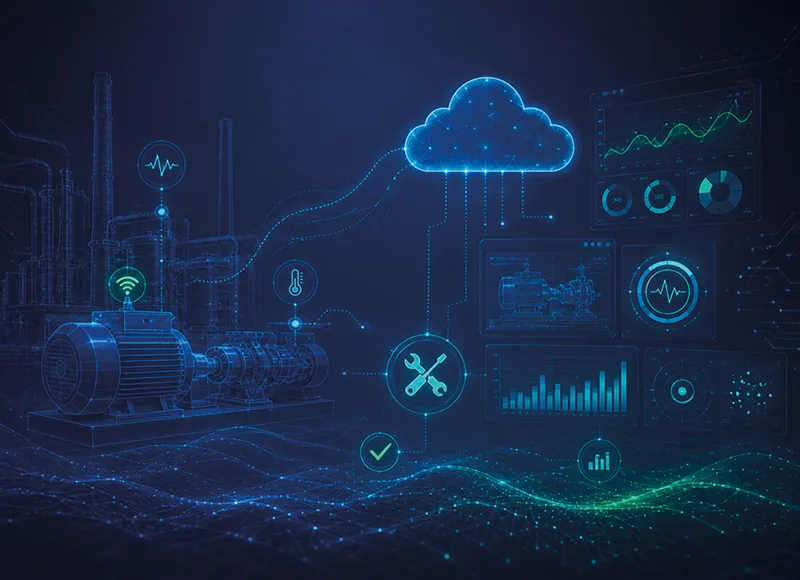
A pilot on a sensitive line (bottling, paper cutting, winding) measures the OEE delta, avoided kWh and fault reduction; if the numbers stack up, scale by department. With XCloud, performance remains tracked over time (parameters, thermal alarms, THD/unbalance trends) and preventive maintenance can be scheduled.
TYPICAL SCENARIOS AND SOLUTIONS
A sag during injection take-out: without protection, the gripper stops mid-stroke, the extruder accumulates material and the imprint is damaged; with Oxygen (<3 ms) the automation never “sees” the event and the cycle completes normally.
Abnormal thermal peaks in LV switchgear: often current THD; an FA40 Active Filter reduces distortion, lowers losses and calms “nervy” protections.
Recurring penalties with an already “stretched” network: power factor correction (HP/FH) frees capacity, reduces I²R losses and stabilises downstream voltage, enabling new loads without rebuilding the backbone.
Multi-line site with actual voltage > nominal: an Enersolve at the head end brings voltage into the efficient window; on backbones with sensitive control logic, add Oxygen Zero for micro-interruptions. Energy savings stay “real” because they aren’t paid for with downtime.
WHAT YOU MEASURE
“It consumes less” isn’t enough. The baseline and the cloud let you present defensible figures:
- kWh avoided through optimisation/stabilisation;
- downtime/scrap avoided thanks to Oxygen/Zero (with timestamps matching events);
- penalties eliminated through power factor correction;
- THD before/after with filtering.
A cautious example: on 4.5 GWh/year at €0.17/kWh, just a 6% reduction from optimisation is worth 270 MWh/year = €45,900/year; with €8,000/year of cosφ penalties eliminated, a €100k capex pays back in about 1.9 years. The best part? Everything is documented – from the single-line overview to exportable reports for incentives and audits.
ORTEA NEXT SOLUTIONS WITH USE CONTEXT
- Orion/Sirius electromechanical stabilisers (2-6000 kVA): complex industrial networks, robustness and continuity in large plants. Aquarius/Odyssey static stabilisers (10-4000 kVA): fast response, critical environments (healthcare, data centres).
- Oxygen / Oxygen Zero: sags and micro-interruptions neutralised within 3-5 ms, up to 2500 kVA; ideal for PLC/drive lines where 200 ms is worth thousands of euros.
- FA40 active filters (60–300 A): cut harmonic distortion in real time in the presence of non-linear loads. HP/FH LV power factor correction and MV panels: eliminate penalties and free capacity even with high THD.
- Enersolve / ComEC: dynamic voltage optimisation with cloud monitoring; ComEC delivers up to ~12% savings in scenarios with stable loads.
THREE SIMPLE (BUT REVEALING) CHECKS
- Ask maintenance when the most annoying faults appear: they often “coincide” with large motor starts or thunderstorms.
- Check (with a thermal camera) transformers and panels at peak hours: if they “run hot”, it’s a sign of THD or overvoltage.
- Look at the electricity bill: the cosφ penalty line tells you a lot about the network’s real condition.
All three lead to the same point: measure – then intervene where needed, in the right order.
WHY ORTEA NEXT
An integrated portfolio (stabilisation, fast-event compensation, power factor correction, filters, optimisation, transformers), system engineering and end-to-end services: from requirement capture to preventive maintenance, with remote monitoring (XCloud) and presence in 100+ countries. That means tailored solutions and reliable roll-outs even across multiple sites.