


In a manufacturing plant, a voltage sag can cause line downtime, and the damage is measured in hours of lost production.
In an operating theatre, the same disturbance affects devices in use on a patient, with a surgical team that cannot pause its work while waiting for power to be restored. This is the difference that makes power quality in healthcare a design issue before it is a management issue: in hospitals, power quality is inseparable from the continuity of clinical services and patient safety.
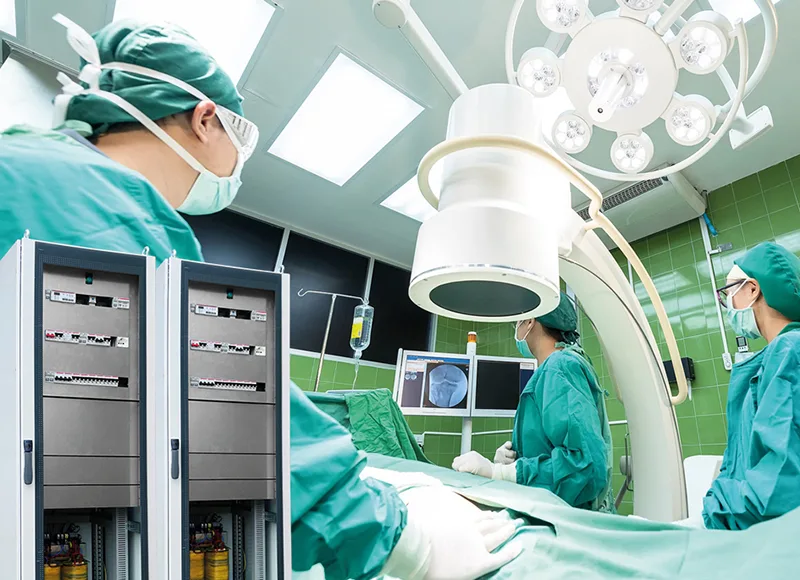
This article looks at power quality from the perspective of those who design healthcare facilities, with a focus on the role of the transformer switchboard for operating theatres, the ISME switchboard, as an element of the electrical architecture rather than a simple distribution component.
WHY POWER QUALITY IS A CRITICAL FACTOR IN HOSPITALS
A hospital brings together very different loads in a single building: electromedical equipment, imaging systems, analysis laboratories, clinical server rooms and air handling systems for sterile areas. Hospitals are among the applications with high electromagnetic sensitivity, alongside data centres and laboratories: environments where even minimal voltage variations or micro-interruptions can cause damage or interruptions.
There is, however, a substantial difference compared with manufacturing. In a factory, electrical continuity is an economic requirement: downtime translates into scrap and higher costs. In a hospital, continuity of service is an operational and organisational requirement: departments such as intensive care, operating theatres and diagnostic imaging must remain operational even when the public grid is affected by disturbances. The risk is not measured solely in financial terms, but in the facility’s ability to deliver clinical care.
For the designer, this changes the order of priorities, putting the reliability of the power supply to critical locations first.
OPERATING THEATRES AND CRITICAL MEDICAL LOCATIONS: THE RISKS OF POOR POWER QUALITY
The disturbances affecting a healthcare facility are the same as on any network: voltage variations, voltage sags, micro-interruptions and supply instability. What changes is the tolerance. A piece of electromedical equipment is a sensitive electronic load: a micro-interruption of a few hundred milliseconds, which would go unnoticed in an office, can result in restarts, loss of settings or temporary unavailability of a function in a critical location.
At the design stage, it is important to size the electrical installation anticipating disturbances that the connected equipment cannot tolerate. Continuity and safety must therefore be guaranteed by the upstream supply architecture, rather than relying on the resilience of individual devices.
WHAT AN ELECTRICAL SYSTEM MUST GUARANTEE IN AN OPERATING THEATRE
Medical locations are designed according to dedicated requirements – in Italy, Section 710 of CEI 64-8, based on the international standard IEC 60364-7-710 – which classify locations according to risk and impose increasingly stringent requirements. Beyond the regulatory reference, an electrical system for an operating theatre must ensure four conditions:
- Continuity of supply: critical loads must remain powered at all times, even in the event of faults or disturbances on the normal supply.
- Isolation: in Group 2 locations, distribution is via a medical IT system (IT-M), galvanically separated from the grid by a medical isolation transformer, so that a first earth fault neither interrupts the supply nor causes hazardous currents.
- Electrical risk control: permanent insulation monitoring, alerting staff before a second fault becomes critical.
- Consistency between installation and intended use: each location must be designed for its own level of criticality, not for a building-wide average.
These conditions cannot be achieved by adding components downstream. They are achieved by getting the architecture right.
THE ROLE OF THE TRANSFORMER SWITCHBOARD IN OPERATING THEATRES
The transformer switchboard for medical locations is the integrated assembly of medical isolation transformer, insulation monitoring devices and protection and switching devices that supplies the location’s medical IT system. In practice, it is the point at which the normal supply is transformed into a supply suitable for an environment where a first fault cannot stop the service.
Its central role derives from three functions that it performs simultaneously:
- It galvanically separates the critical location from the rest of the network, containing external disturbances and faults.
- It enables continuous insulation monitoring, which in Group 2 locations is the real line of defence: the first fault is signalled, not interrupted.
- It defines the changeover point between the normal and standby supply for the location’s loads.
A switchboard designed for this function has a direct impact on system safety: the quality of the power supply in an operating theatre is, to a large extent, the quality of its transformer switchboard.
ISME SWITCHBOARD FOR OPERATING THEATRES: WHEN AND WHY IT BECOMES A STRATEGIC DESIGN CHOICE
In medical locations, the switchboard is not just one distribution component among others: it is the hub between the facility’s general installation and the electrical island of the critical location. For this reason, the choice of the ISME switchboard should be addressed at the design stage, when the supply architecture, switchboard locations, changeover logic and monitoring criteria are defined. Correcting a wrong upstream choice further downstream always costs more, and in a hospital setting it often means working on departments that are in operation.
A solution designed specifically for operating theatres meets the typical needs of the hospital designer: compliance with the requirements for Group 2 locations, integration between the transformer, insulation monitoring and staff alarms, and coordination with the safety power supplies. The value lies not in the individual component but in the coherence of the whole, verified before commissioning.
DESIGNING FOR CONTINUITY: WHAT TO CONSIDER IN A HOSPITAL ENVIRONMENT
Experience on healthcare projects suggests reasoning in levels, starting from the loads and working up to the architecture.
SENSITIVITY OF ELECTROMEDICAL EQUIPMENT
Each location houses equipment with different tolerances to disturbances. A survey of the loads, with their respective sensitivity to variations and interruptions, is the starting point for any serious installation choice.
CONTINUITY OF SERVICE IN CRITICAL LOCATIONS
For each location, the acceptable interruption time must be defined, distinguishing between loads that can tolerate changeover to a standby supply and loads that cannot tolerate any perceptible discontinuity.
VOLTAGE STABILITY AND POWER SUPPLY QUALITY
In addition to continuity, a stable voltage is needed: measuring, diagnostic and laboratory equipment is affected by variations even when the supply is not interrupted.
SYSTEM ARCHITECTURE AND INTEGRATION OF PROTECTION DEVICES
Isolation transformers, insulation monitoring, changeover and protection devices must be designed as a single system. Protection devices added at different times without coordination are one of the most frequent causes of abnormal behaviour in operation.
CHOOSING DEDICATED SOLUTIONS BASED ON THE CRITICALITY LEVEL OF THE LOCATION
Not every part of the hospital requires the same level of protection. Concentrating the most advanced solutions where the risk justifies it keeps the project sustainable and avoids spreading the budget thinly across ordinary areas.
POWER QUALITY IN HOSPITAL SETTINGS: WHICH SOLUTIONS CAN SUPPORT OPERATIONAL CONTINUITY
The ISME switchboard safeguards the critical location of the operating theatre, but it is only one piece of a hospital’s power quality. In a highly sensitive context, solutions must be chosen according to the problem to be solved, with a systemic and integrated approach.
For medical locations, the answer is the dedicated transformer switchboard. For areas where the problem is micro-interruptions, such as clinical server rooms or diagnostics, there are supercapacitor-based compensators such as Oxygen Zero, with response times of less than 5 ms, which are also suitable for hospital environments. Where the problem is voltage instability, static voltage stabilisers, with no moving parts, are used in hospital applications and medical equipment precisely because of their fast response.
The integrated Ortea Next portfolio, with solutions tailored to every installation requirement, makes it possible to combine these elements into a coherent project rather than adding up isolated devices.
WHY HOSPITAL DESIGNERS NEED A RISK- AND CONTINUITY-ORIENTED APPROACH
Each area of a hospital has a different level of criticality, and electrical design must follow the intended use of the location, not generic building-wide standards. This means treating power quality as part of installation safety: the right upstream choices, from the supply architecture to the transformer switchboard, reduce the operational vulnerabilities that would otherwise emerge downstream, when the margins for intervention are minimal.
In critical medical locations, power quality must be designed with the same care given to system continuity and safety. To assess the most suitable solution for operating theatres and sensitive hospital environments, the most useful starting point is a technical analysis of the specific application.
FAQ ON POWER QUALITY IN HOSPITALS AND OPERATING THEATRES
WHY IS POWER QUALITY IMPORTANT IN HOSPITALS?
Because hospitals are environments with high electromagnetic sensitivity: electromedical equipment and digital clinical systems are affected even by micro-interruptions or minimal voltage variations. Poor power quality puts continuity of service in critical departments and equipment reliability at risk, and therefore has a direct impact on the safety of the clinical environment.
WHICH HOSPITAL AREAS ARE MOST SENSITIVE TO ELECTRICAL DISTURBANCES?
The most sensitive are Group 2 medical locations, where equipment may be used on a patient in a critical condition: operating theatres, intensive care units and delivery rooms. These are followed by diagnostic imaging, analysis laboratories and clinical server rooms, where electrical disturbances can cause restarts, data loss or equipment unavailability.
WHAT MUST THE POWER SUPPLY GUARANTEE IN AN OPERATING THEATRE?
It must ensure continuity of supply to critical loads, galvanic separation via a medical isolation transformer, permanent insulation monitoring with first-fault alarm, and reliable changeover to standby supplies. In Italy, the requirements for medical locations are set out in Section 710 of CEI 64-8, based on the international standard IEC 60364-7-710.
WHAT IS A TRANSFORMER SWITCHBOARD USED FOR IN AN OPERATING THEATRE?
The transformer switchboard supplies the medical IT system of the critical location: it galvanically separates the operating theatre from the rest of the network, integrates permanent insulation monitoring and manages the protection and changeover of the location’s loads. It is the element that allows a first earth fault to be signalled without interrupting the power supply to the equipment.
HOW DOES POWER QUALITY AFFECT A HOSPITAL’S OPERATIONAL CONTINUITY?
Disturbances such as voltage sags and micro-interruptions can stop or restart diagnostic equipment, clinical IT systems and ward loads. Every period of unavailability translates into postponed examinations, reorganised activities and equipment to be re-checked: power quality is therefore an operating condition of the facility, not an installation detail.