



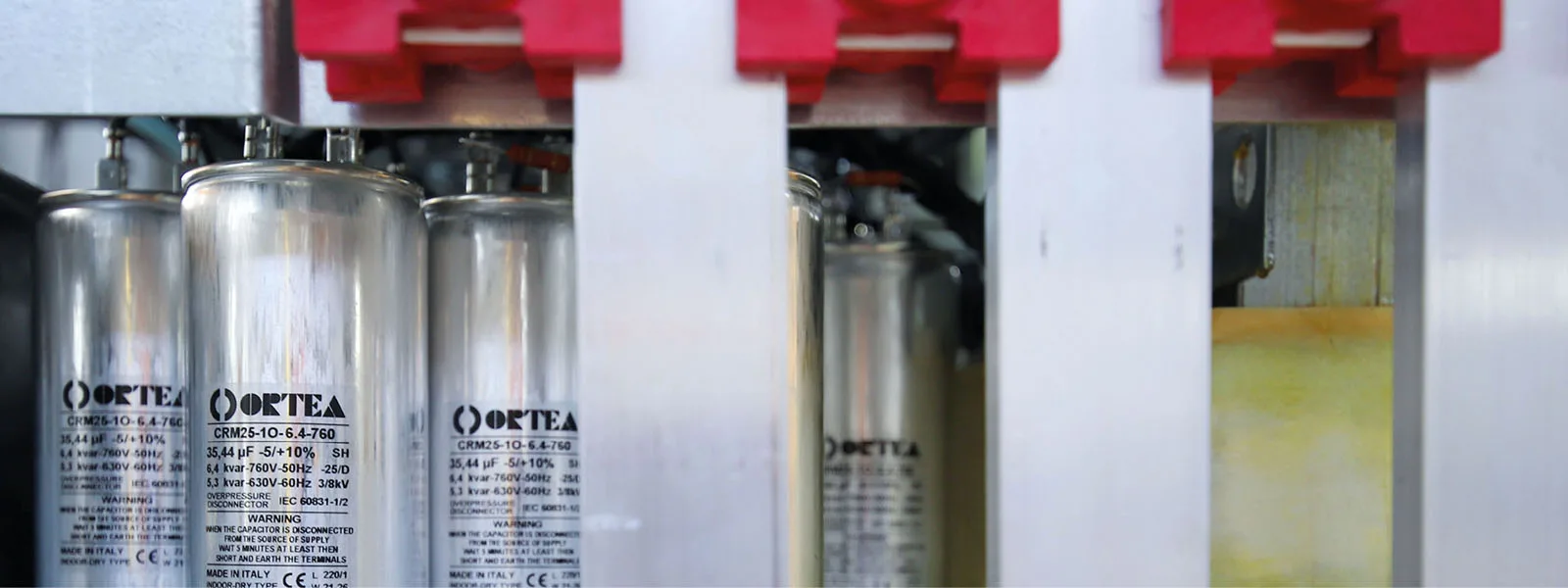
WHAT POWER FACTOR CORRECTION IS AND WHY IT MATTERS IN INDUSTRIAL PLANTS
Power factor correction systems are one of the most effective solutions for improving the energy efficiency of industrial electrical installations. When inductive loads are present – such as motors, transformers, welding machines, compressors, and other machinery typical of production environments – a portion of the absorbed energy is not converted into useful work, but remains engaged as reactive energy.
Power factor correction equipment compensates for this reactive energy, improving the installation’s power factor. The result is more efficient management of the internal power grid, with several tangible benefits:
- Reduced losses
- Lower circulating current
- Better utilisation of available power
- Reduced overload on transformers and lines
- Greater plant stability
- Containment of penalties applied by the distributor for low cosφ (where applicable).
In an industrial context increasingly oriented towards energy efficiency and operational continuity, power factor correction is therefore not merely a cost-reduction solution, but a genuine tool for optimising electrical infrastructure.
A SPECIAL SUPPLY FOR A LONG-STANDING PARTNER IN THE MIDDLE EAST
Ortea has recently completed a new supply for a long-standing partner located in the Middle East, once again confirming the company’s ability to develop tailored solutions for complex applications and international markets.
The order concerns automatic LV power factor correction equipment, designed to operate at 60 Hz and manufactured in 19 different power sizes, ranging from 100 kvar to 1825 kvar. A particularly varied supply, developed to meet different plant requirements and very precise technical specifications.
The equipment was designed for four different voltage levels: 400 V, 440 V, 460 V, and 480 V. All units are equipped with harmonic blocking reactors tuned to 216 Hz – a fundamental technical choice to ensure reliable operation even in the presence of harmonic distortion and to protect capacitors from potentially critical operating conditions.
Particular attention was devoted to equipment with supply voltages of 440 V, 460 V, and 480 V, for which dedicated disconnectors and purpose-designed capacitors were specified. This choice allows the solution to be adapted to the specific electrical conditions of the installation, improving the reliability, safety, and operational life of the equipment.
CUSTOM DESIGN ENGINEERING
The true added value of this project lies in the meticulous custom design work carried out by Ortea, to meet the client’s requirements with precision.
Each piece of equipment was developed taking into account real operating conditions, network characteristics, and the application requirements of the destination site. This approach required careful evaluation of components, operating currents, internal switchboard layout, and thermal management.
A major engineering challenge concerned the development of equipment rated above 960 kvar, up to the peak of 1825 kvar. Managing equipment of this power rating entails overcoming considerable physical and electrical challenges:
- High dimensioning current values: the high currents flowing through the internal distribution busbars require rigorous calculations on electrodynamic withstand capability under short-circuit conditions and meticulous selection of conductive materials.
- Mitigation of thermal stress and internal temperatures: the Middle East is characterised by extreme external ambient temperatures, often exceeding 50°C. Inside a power factor correction switchboard, the heat generated by the Joule effect from the reactors and the passage of large currents risks compromising the performance of the capacitors – components notoriously sensitive to heat.
ORTEA: A PARTNER FOR INDUSTRIAL ENERGY EFFICIENCY
Engineering equipment of this rating cannot be approached with standardised solutions. It requires technical expertise, application experience, and the ability to interpret client requirements and translate them into a robust, efficient industrial solution that is coherent with the installation conditions.
Choosing Ortea means relying on a partner with solid experience in the design and manufacture of solutions for power quality and industrial energy efficiency. In a market where energy is increasingly a strategic factor for business competitiveness, Ortea positions itself as a reliable partner for transforming power quality into a concrete advantage.
FAQ
WHAT IS POWER FACTOR CORRECTION AND WHY IS IT IMPORTANT IN INDUSTRIAL PLANTS?
Power factor correction compensates for the reactive energy absorbed by the inductive loads present in industrial plants, improving the power factor. This makes it possible to reduce circulating current, limit losses, optimise the use of available power, and improve the overall efficiency of the electrical infrastructure.
WHAT ARE THE BENEFITS OF INSTALLING POWER FACTOR CORRECTION EQUIPMENT?
Power factor correction systems contribute to improving the energy efficiency of the installation, reducing the overload on transformers and lines, increasing the stability of the internal power grid, and avoiding any penalties related to a low power factor, where provided for by the electricity supply contract.
WHY WERE HARMONIC BLOCKING REACTORS TUNED TO 216 HZ USED?
Harmonic blocking reactors tuned to 216 Hz were integrated to protect the capacitors and ensure reliable operation even in the presence of harmonic distortion. This solution reduces the risk of resonance and increases the operational safety of the equipment.
WHY DOES EQUIPMENT ABOVE 960 KVAR REQUIRE SPECIFIC DESIGN?
Equipment rated above 960 kvar is characterised by high dimensioning current values and potentially significant internal temperatures. For this reason, it requires careful electrical and mechanical design, with particular attention to component selection, conductor sizing, internal layout, and thermal management.
HOW DOES ORTEA CUSTOMISE ITS POWER FACTOR CORRECTION SOLUTIONS?
Ortea develops its equipment starting from the client’s specific requirements and the real operating conditions of the installation. In the case of this supply, the solutions were manufactured in 19 different sizes, with four voltage levels and dedicated components for certain configurations, confirming a bespoke design approach.


