



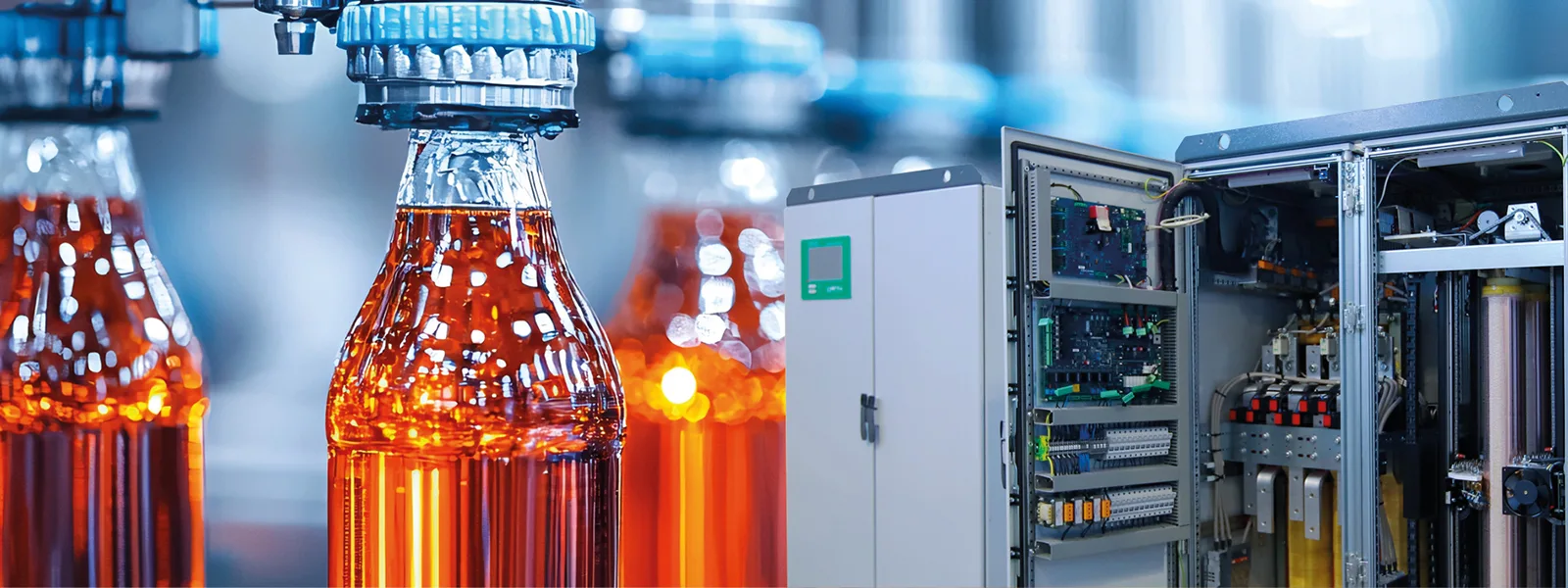
In the food&beverage industry, electrical stability isn’t a “nice to have”: it’s a necessary condition to ensure productivity, quality and compliance with delivery windows. A single voltage anomaly is enough to trigger sudden stops, control resets, product waste and efficiency losses.
That’s why a major beverage company in Latin America chose Ortea to secure some critical line loads, with a supply of five SIRIUS voltage stabiliser five SIRIUS voltage stabilisers.
WHY IN LATIN AMERICA VOLTAGE IS NEVER “A GIVEN”
In several areas of Latin America, continuity and reliability of distribution still have room for improvement: for businesses, this translates into a higher risk of grid disturbances that directly affect productivity.
In industrial sites, voltage variations are particularly critical. They can occur even when values fall within standard tolerances yet still prove “annoying” for sensitive loads and continuous processes.
WHY VOLTAGE FLUCTUATIONS ARE CRITICAL IN FOOD&BEVERAGE
Modern beverage lines concentrate many sensitive technologies along the process: blow moulding, filling, labelling, packaging, handling, as well as services such as compressors and refrigeration.
In this context, undervoltage and overvoltage can result in:
- line stoppages and slow restarts (PLC/drive resets, anomalies on sensors and actuators)
- production blocks on highly automated machines (packers, palletisers, etc.)
- waste (out-of-spec product, non-compliant packaging, interrupted batch)
- stress and failures on motors and power supplies (reduces the service life of electronic components and increases maintenance)
It’s no coincidence that many power quality analyses highlight voltage variations as among the most frequent causes of industrial malfunctions. In food&beverage, automated bottling/packaging and refrigeration systems are especially vulnerable to this type of disturbance.
THE RIGHT APPROACH: STABILISE THE VOLTAGE BEFORE IT REACHES THE MACHINES
When the main issue is variability of the incoming voltage, the most effective strategy is often not to chase failures “downstream” machine by machine, but to stabilise the supply upstream of the switchboard/line (or specific departments), so as to deliver a constant and predictable voltage to the loads.
That’s where the voltage stabiliser comes in: a device designed to automatically correct grid deviations and keep the output value within tight tolerances, continuously.
THE ORTEA SOLUTION: 5 THREE-PHASE SIRIUS 480V UNITS FOR CRITICAL LINE LOADS
For this project, Ortea supplied five three-phase SIRIUS voltage stabilisers at 480V – 60Hz, all with an input range of ±15% and output accuracy of ±0.5%.
Specifically, the supply includes:
- 2× SIRIUS 250 kVA
- 2× SIRIUS 400 kVA
- 1× SIRIUS 800 kVA
The stabilisers are intended for line sections related to blow moulding and packaging, where even a single anomaly can quickly propagate in terms of plant downtime, product waste and overall efficiency loss.
WHY SIRIUS: “TOP-PERFORMING” STABILISATION FOR HIGH POWER
For this project, the proposed solution was Sirius, a three-phase electromechanical voltage stabiliser designed for demanding industrial applications, where precision, robustness and advanced diagnostics are required.
Here’s what makes it particularly suitable for highly automated beverage plants:
- Output accuracy ±0.5%: protects sensitive loads and reduces undervoltage/overvoltage.
- Advanced control in true-RMS with multi-microprocessor architecture (DSP + “bodyguard” supervision) for reliable regulation even with complex disturbances.
- Integration and diagnostics: remote communication can take place via Ethernet, with the possibility of screen replication via VNC and data exchange via MODBUS TCP/IP.
- Maintainability and prevention: a roller diagnostics system (OMR) is available, enabling checks on operation/temperatures and indicators useful for planned maintenance.
One often underestimated point: selecting the correct input variation range is decisive. If the actual voltage exceeds the selected nominal range, the error “adds up” to the accuracy and performance worsens: that’s why Ortea always recommends a safety margin when choosing the range.
WHY CHOOSE ORTEA AS A PARTNER
When power quality impacts production and quality, a “product” isn’t enough: you need a partner who can understand the process and translate it into electrical specifications, installation and validation.
Voltage stabilisers, for example, are designed for industrial contexts and aim to protect equipment and operational continuity, with a wide range available.
FAQ
WHY IS A VOLTAGE STABILISER NEEDED IN A BEVERAGE PLANT?
Because voltage variations can cause shutdowns/malfunctions of equipment, with downtime and product loss (stops, waste, slow restarts).
WHERE IS IT BEST INSTALLED IN A BEVERAGE PLANT?
Typically upstream of sections where a disturbance generates “cascading” effects: blow moulding, packaging, lines with many inverter/servo and electronic controls.
DOES A STABILISER ALSO ELIMINATE BLACKOUTS?
No: the stabiliser regulates voltage when the grid is present but unstable. For a total loss of power, dedicated solutions are required (e.g. UPS). Sirius includes protection functions and return-to-optimal-voltage management as per the datasheet, but it does not replace a continuity system where needed.
WHY ARE INVERTER (VFD) SO SENSITIVE?
Because they protect the DC bus and internal electronics: a voltage variation can trigger protection and stop the line. This is a known behaviour and widely covered in industrial technical guides.
IS IT BETTER TO PROTECT THE WHOLE PLANT OR ONLY CRITICAL LOADS?
It depends on the data (magnitude and frequency of variations, power, electrical architecture). The most effective choice comes from a Power Quality measurement and sizing consistent with the real grid and load profile.


